Meet the Artist // Maria Máximo
Her process involves subjective actions beyond conscious control. Recent work evolved through material experimentation, developing a language that articulates personal experiences by exploring the subtraction of matter. Her practice lies at the intersection of body, machine, and matter, encompassing sculpture, installation, performance, drawing, and mechanical-optical experimentation. She investigates tensions between control and freedom, using the body as subject, material, and tool to explore the Post-Body concept when human gesture and machine become one.
Can you tell me a little about yourself?
I’m Maria, I’m 25 years old, and I live in Portugal, in Lisbon. I grew up in the south, and then I changed cities to study painting. After spending six months through Erasmus in Paris, I came back to Lisbon for my MA in painting, which I wrapped up this year.
Your work has been described as a form of “emotional archaeology.” Can you introduce yourself by telling us how your personal experiences and memories, perhaps even those dating back to your childhood, have driven you to dig into these emotional layers through your art? How has this short period in Berlin influenced you and your relationship with the Camões Institute, and regarding your upcoming projects?
I consistently align my personal interests with my work. It’s very personal how I began to have a relationship with art. I’ve always aligned my personal interests with my work, and my relationship with art started in a deeply personal way. Growing up, I went through a difficult time with my family, and around the age of 14 or 15, I found an escape in drawing. It was the one thing I could do entirely on my own, an essential outlet from my environment. As it turned out, I had a natural talent for it, which surprised my parents. So I told them I wanted to pursue a path in art. My decision was also tied to my grandfather’s legacy. He had always wanted to be an artist, but growing up in Portugal before the April 25th Revolution under the dictatorship, his family was poor and worked in agriculture, so he was never allowed to study art. In a way, pursuing this path felt like continuing a legacy that had been forbidden to him. Knowing that, my parents fully supported my studies.
At the beginning of art school, I did painting in the first year and the second year, as traditional figure drawing and painting were required. After this, I discovered installation and video, as well as other materials. I worked a lot with found materials. At the time, I didn’t know exactly what I was working on. I was just projecting my memories and personal experiences on those pieces. But it was very free in the way that I didn’t project like a piece; I was just working. Step by step, I gained a clearer consciousness of my process. For example, the themes I wanted to expand to a large audience, not just like my personal stuff. During that time; it was a personal archaeology of things that I was like excavating through trauma to like catharsis and everything.
To balance out that heavier, darker phase of my work, I started incorporating childhood memories. It became a lighter, more poetic way to reconnect with my own past.
I had so many memories I could transform into art, like creating a video piece featuring a small wooden raft, inspired by Peter Pan, or exploring more abstract concepts like the idea of a ‘hole’ or absence.
That said, I’m naturally impatient with my process. If you look at my portfolio, you’ll see a wide range of media because I quickly tire of just one material or theme. Exploring childhood memories was a beautiful era in my work, and while that thread remains, it has evolved into something less literal.
This impatience and curiosity naturally pushed me toward performance and exploring new media. I also started collaborating with artisans to fabricate certain elements. For instance, when I first worked with metal, I spent nearly nine months on a single piece, so delegating technical aspects allows me to keep experimenting without getting stuck in the learning curve. I mean, I’m not that strong. I have strong hands, but I don’t have strong arms. So it was a lot. But then I miss that part of getting my hands in the work.
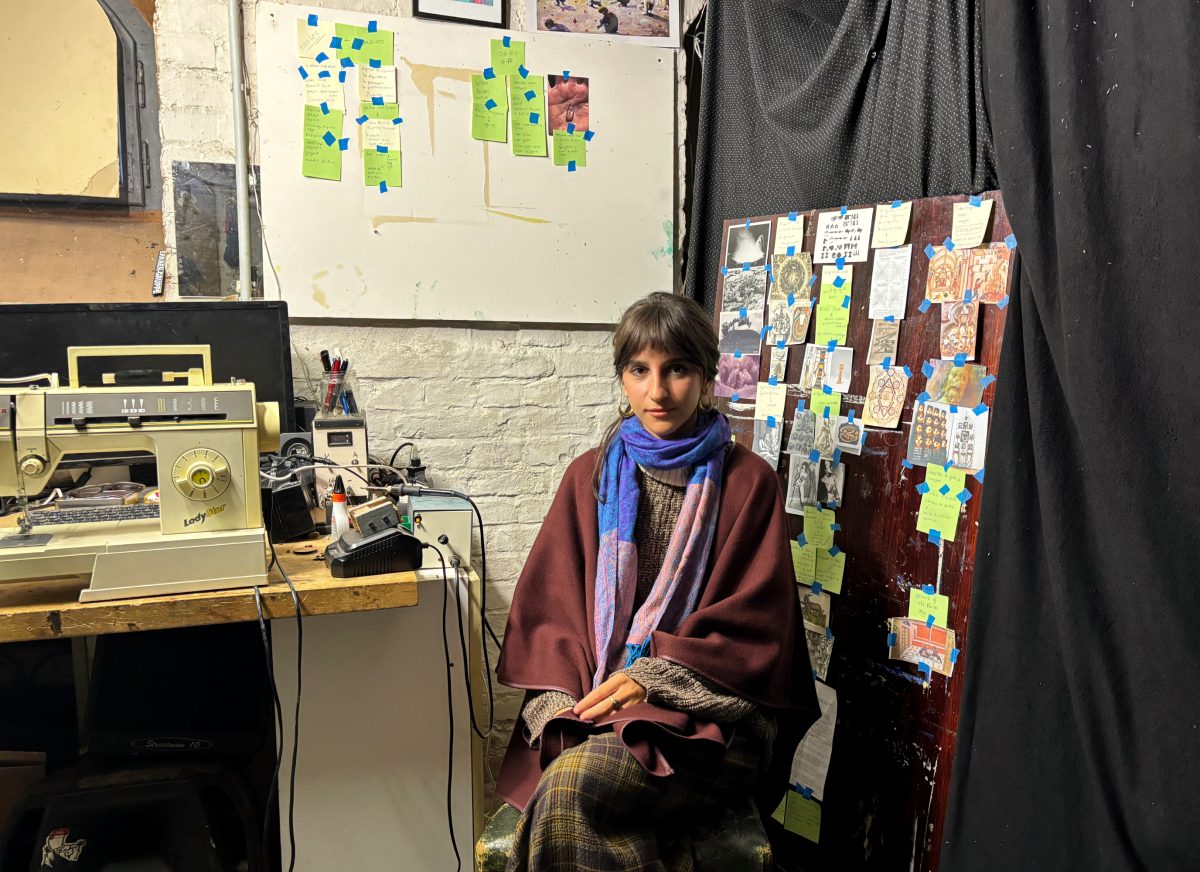
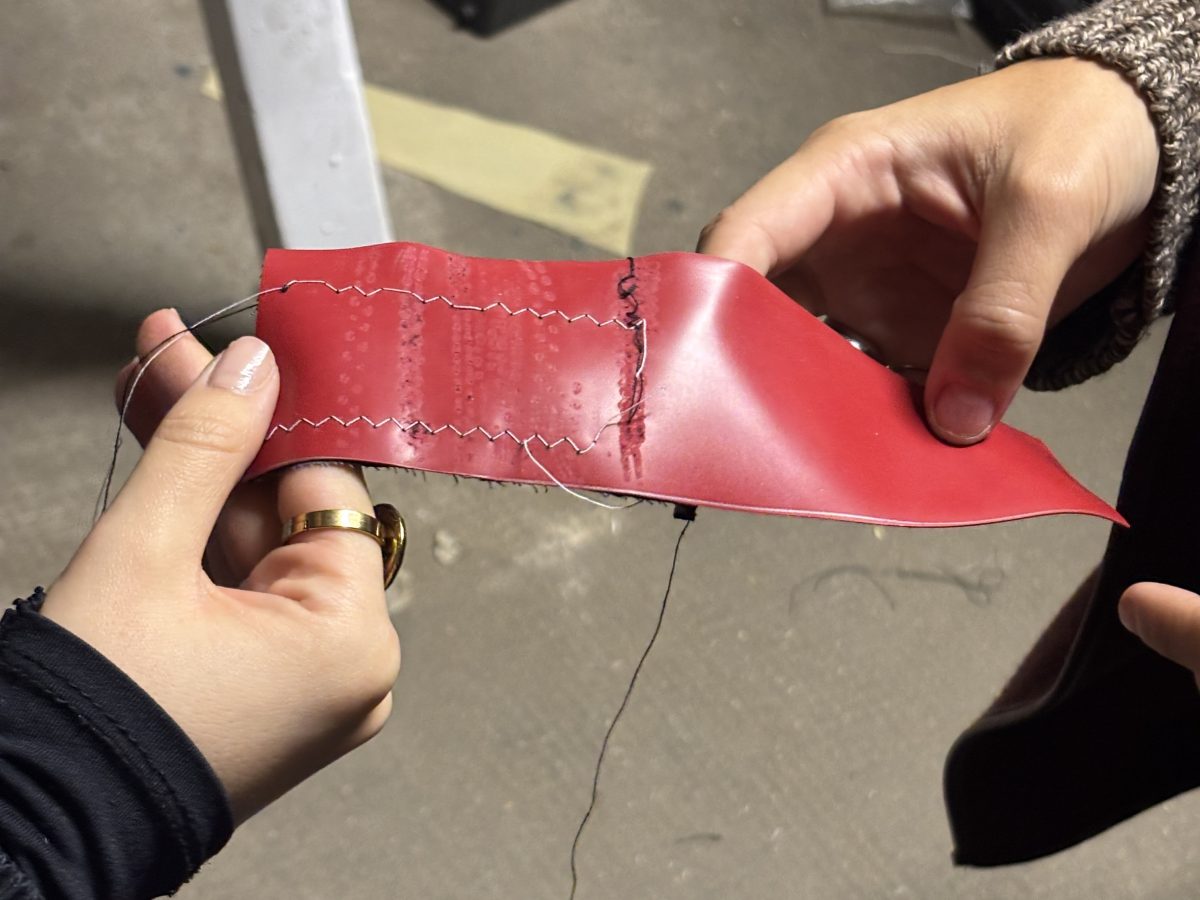
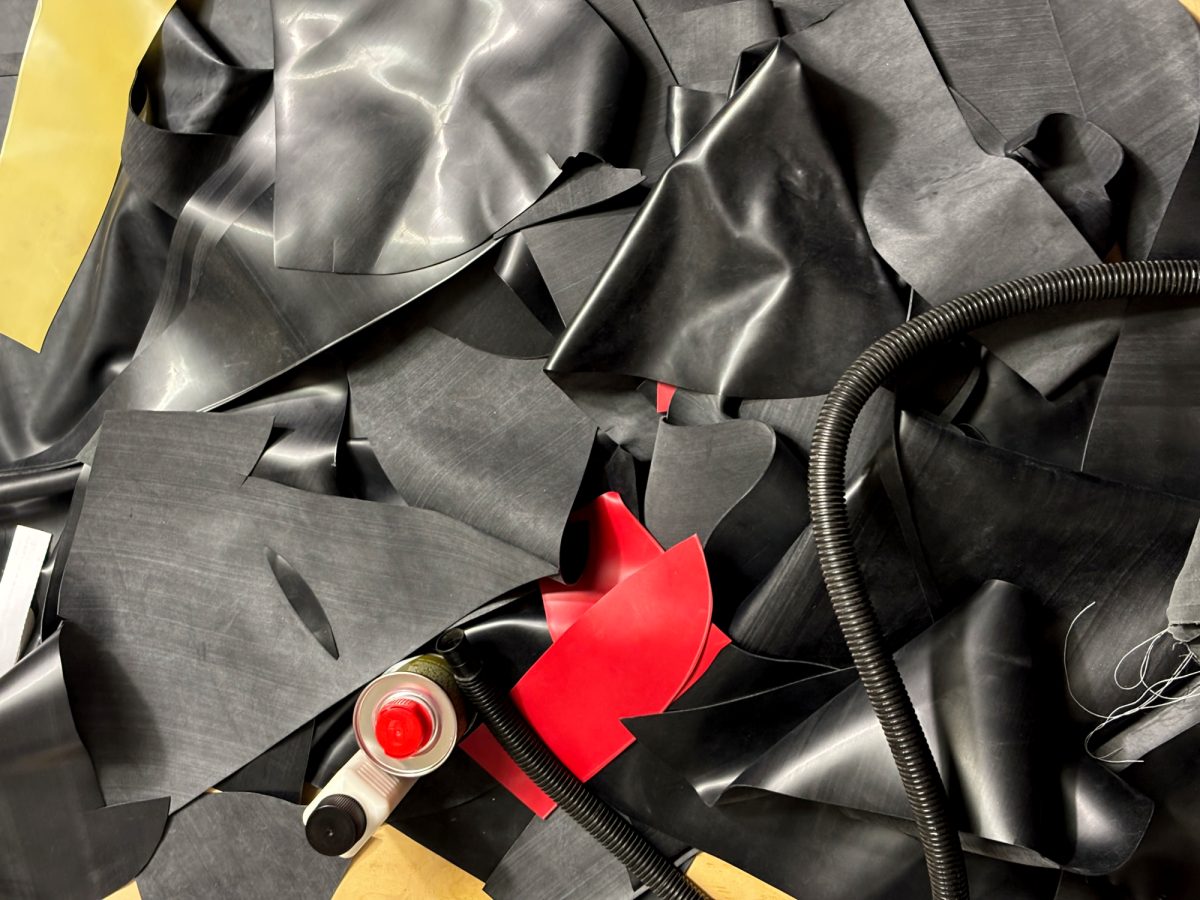
Now I’m doing both of those things. I want to work manually again. That’s why I’m working with the sewing machine here.
The period here was a beautiful time for me because in Portugal, and I think in many countries, artists can’t make a living by just being an artist. So this year I worked as a teacher for kids. Because of that, I didn’t have so much time to work in my studio.
But by being here, I got the chance to come back to my work, to get new ideas, to see a lot of new things. Thanks to Galeria Nave, thanks to Camões Berlin, thanks to GlogauAIR. Now that I’m about to go back to Lisbon, I want to remain in this rhythm and get a job. Because I need to survive, but not too many hours, so I can make art again.
 Your process often relies on a “subtraction of matter” to articulate personal traumas and reveal plastic or architectural forms. How did you arrive at this method of excavating material, and why does drawing remain such a cathartic tool for you?
Drawing serves as a primary space for emotional articulation. For artists navigating deep trauma, creative expression provides a necessary outlet to channel complex experiences constructively. Through my practice, I found a way to externalize these internal states. However, I distinguish art-making from clinical therapy. While therapy relies on structured verbal reflection, the artistic process operates abstractly, reaching beyond language to materialise forms that cannot be translated into words.
 There is an intriguing duality in your work; it feels like an ancient, alchemical soul operating through contemporary mechanisms like lasers, mirrors, and motors. How do you use these modern devices to evoke this tension between human vulnerability and machine precision?
The machine was very present in my last project. The most recent investigation I did on it was back in April when I defended my thesis. During the defence, the committee questioned me about aspects I hadn’t intentionally embedded in those pieces, like spirituality and sexuality. When different people analyse your work, they bring perspectives you hadn’t considered.
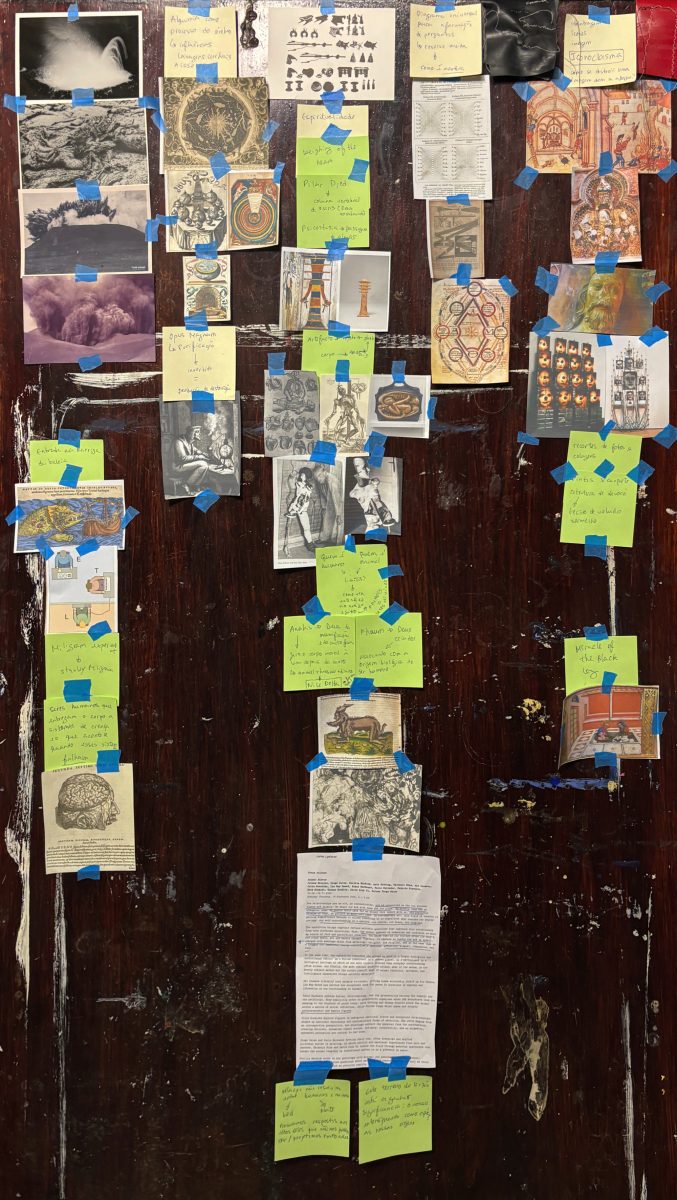
That sparked my interest in exploring those themes in this new phase. Naturally, that led me to alchemy. As you can see on this panel (shows moodboard), I use Post-its to map out and organize my ideas. I’m connecting spirituality to ancient history, like Egypt, and exploring how that manifests in the body: what defines the human versus the animal, and where those boundaries lie.
I recently saw an exhibition here featuring a video with the sequence: artifact, object, plant, animal, human. It got me thinking about reversing that order. My interest often sits with the artifact, which, before becoming an artifact, was simply an object. Objects from our contemporary life will eventually become artifacts too. I find this fascinating because human history is filled with mysteries, like ancient Egyptian tools that were surprisingly advanced for their time.
I used to link this to the machine at an extreme level, but I’ve grown a bit tired of sophisticated technology; it’s a very saturated topic right now. My interests are shifting. I don’t want to break completely from my previous work, but rather allow a slow, organic transformation into unpredictable territory.
I use the term alchemy partly because I do Jungian therapy, so my process is deeply connected to my dreams and their symbolism. Spirituality is such an open domain that it can even encompass religion.
Interviewer // Mariella Raia
Photos // Danae Ripley