Meet the Artist // Kami Million
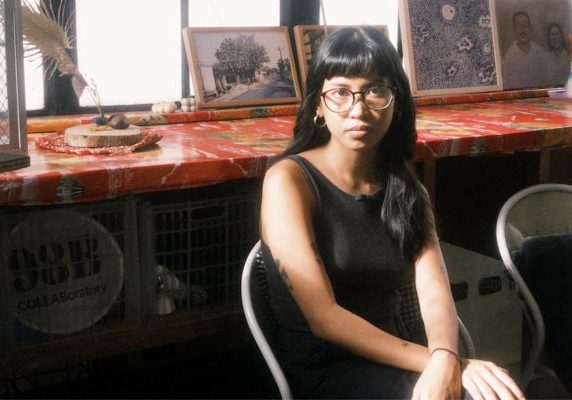
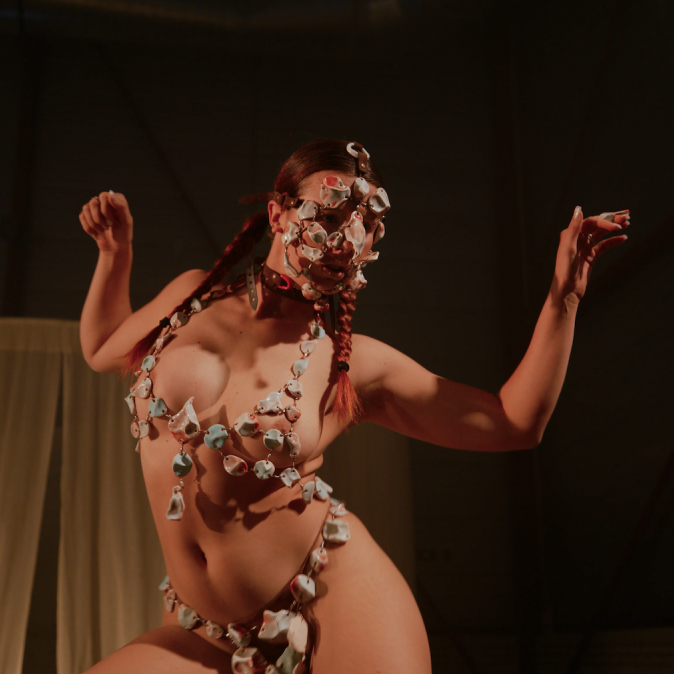
Kami Million is a chameleon who cycles between different alter-ego’s depending on each context—the mystical pigeon, the farmer dyke, the super-femme stripper, the caring facilitator. Kami hides in order to reveal. They use performance, community gatherings, ceramics, paintings and writing as tools to communicate and feel through, working to destigmatise and decriminalise sex work and deconstruct power relations. They organise talks, dinners, collective writing sessions, film screenings and club nights where sex workers and their allies are invited to gather, to generate more care and visibility for the community of Whores. Their work is both affective and direct, with gestures of care, embracing the contradictions that come with living multiple lives.
Could you tell me a bit about yourself and the project you are proposing for your three-month residence here at GlogauAIR?
The common thread in my work is to translate sex worker experiences, aiming to help destigmatize our field and create space for our community to exist. My practice is kind of split up: there’s two islands and one of them is my personal practice that includes ceramics, performance, painting and writing, the other one is the organizing I do for our community where I position myself as a facilitator.
Me and the people I work with do gatherings for sex workers in which we try to create a space for softness. I did quite some hands-on activism on the streets, here I experienced and saw people dealing with exhaustion and burnout, and felt the need to create spaces in which we can be soft and can whisper and still be heard. Often, sex workers have to scream in order to be heard, or are not heard at all. We have been organizing the Pleasure Providers Pillow Talks which is a gathering in a bookstore where sex workers are invited to share stories in their own way. Next to that we have been doing collective writing and pleasure sessions as well as performance club-nights. This element of facilitating always influences the other side of my practice.
Since I do a lot of organizing, in combination with working in the night, and having my practice, I’m usually quite busy. When I came to GlogauAIR, I was really excited to dive deeper into my more personal practice and find a temporary space of focus.
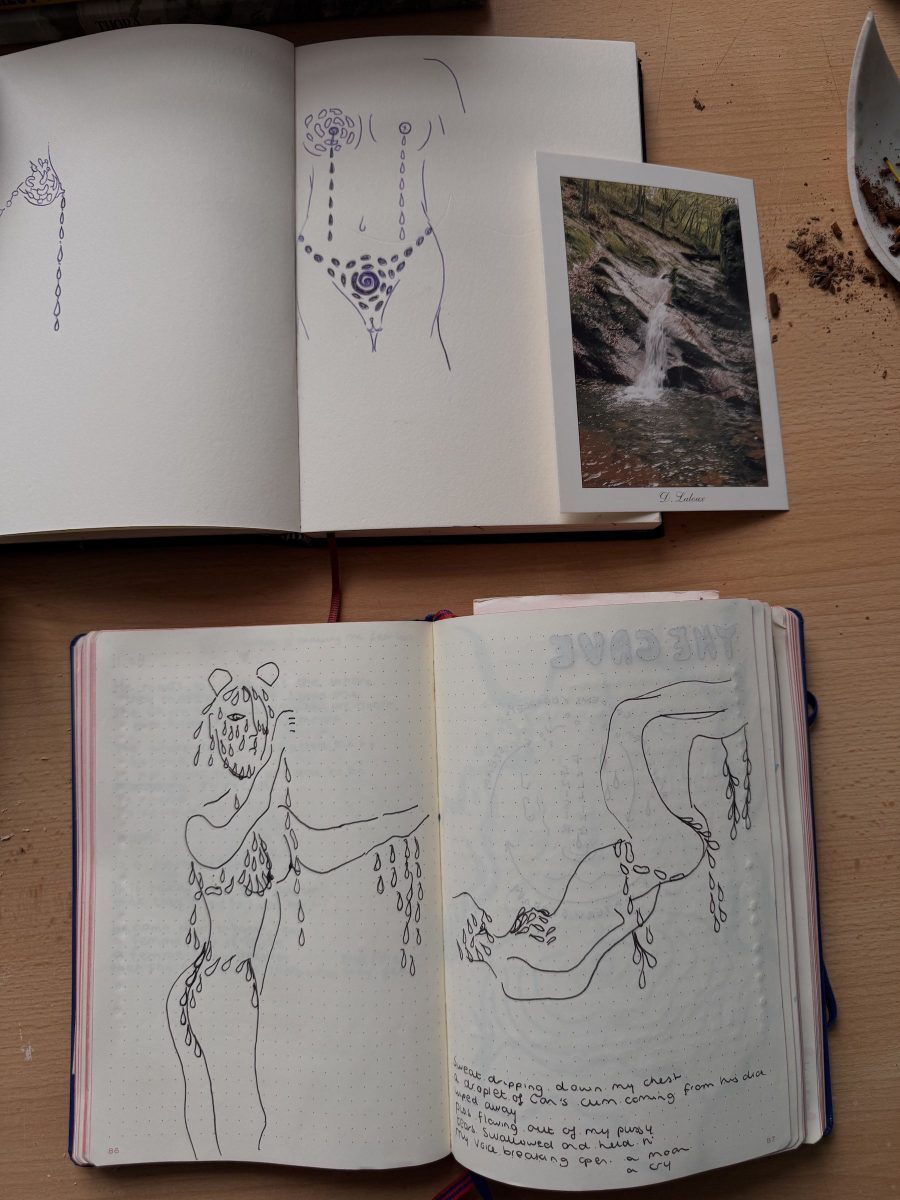
I came here with the idea to make a work about body fluids and its relationship to release. I want to create a space in which I can honor the grief and sadness that the sex work community experiences. And also acknowledge how closely pleasure and love are connected to grief. As a community that is so stigmatized it is challenging to share feelings of grief, since they can be used as a weapon against us. There’s a lot of hate, there’s a lot of stigma, there’s a lot of discrimination. Therefore, we often have to have a very straight spine and only show our strong side, which makes it hard to show more of this vulnerable side.
I wanted to create a work in which I can honor that vulnerable side, because next to joy and strength, there is also sadness and grief within our community. My intent will be to work with ceramics and make a wearable piece as well as to work with sound and eventually make a performance with that.
Your current work deals with bodily processes that are very intimate. What do you think changes when these moments become visible through art, and how do you want viewers to sit with that discomfort or intimacy?
Indeed, bodily fluids, release, and sadness are all very intimate but also very much universal experiences that everyone can relate to in their own way. As a sex worker, intimacy is something that we interact with a lot, we are able to do this with complete strangers or
clients that come back and become familiar, this makes us experts at holding space for this intimacy.
I think from there came the desire to give a little bit of that to those who don’t know our world, because our reality is very hidden and mysterious because of the stigma, but also because this hidden intimacy is something that I believe people can relate to. I want to grab a little bit of that and actually put it out there, my hands in an open gesture, inviting, almost offering it to an audience. I don’t think it’s up to me to decide how an audience sits with that or feels about that, all I can do is be aware of what I offer.
It’s not my goal to trigger. It would be more so an invitation- and maybe, by showing my own vulnerability or putting myself in a very vulnerable place- to invite others to also have a moment of vulnerability with each other after looking at this piece. And hopefully we can create some space to share this intimacy and grief, but also pleasure which can be so close or together with the sadness.
Experiences of grief are very personal and beautiful and I understand how we protect this space, simultaneously there is also a beauty in sharing these experiences because it is such a collective experience as well. I hope to invite people to see a little part of our community that’s so hidden. And more importantly, for our community to see themselves, to go back to a place of release and feel it in togetherness.
The most beautiful thing with my practice is to perform for my own community; they can feel it the clearest because it comes from our lived experience. At the same time I attempt to create a bridge between my community and allies, and after that civilians, who could potentially become allies after understanding us better.
You describe yourself as a chameleon and being able to change between alter-egos. What does each persona make possible that a singular identity would not?
I live in very different worlds, coming from a tiny small village, a real farmer environment, to then living in different places and bigger cities, being part of the art community, finding my ways into more anarchist spaces and activism, being part of the nightlife industry that can be sometimes glamorous, and sometimes a horribly exhausting kind of space. One day dancing to 220 BPM Dutch farmer gabber in a big crowd and the other day having a critical conversation on queer feminism in a bookstore.
I need the different alter egos to move through all these spaces and to be able to connect with different people in different ways. I see them as sort of layers or masks. That’s why I use masks, drag make-up, and ceramics as a kind of armor around my body and face. Playing with anonymity, or choosing which layer of a persona I want to show is something I am always thinking of.
I view our identity as layers that sometimes are transparently layered on top of each other, its variety visible. Other times, I decide to put some layers away and hide them under a
more opaque mask that only shows one version of a certain alter ego or version of myself. Depending on the context and who will be watching.
Earlier in my career as a whore, I had to fully hide, nobody knew I was doing it. Still today I have to hide in moments, I found my way to be more out there but it is still hard to deal with stigma and its effects. Many sex workers have to hide what they do because they might lose their other job, because they are mothers and fear having their children taken away from them. Maybe they’re in a family that wouldn’t accept it, or even because laws can make your landlord pass as a so-called pimp, which is not the case at all.
Hiding can be painful and come from a place of survival. At the same time there can be a certain power, or joy from being able to isolate a part of yourself, live that version of you and then put that mask back in its box until it can come out again. The idea of hiding in order to reveal is something I think of a lot in my practice.
How do you decide which medium (ceramic, painting, performance) best suits a particular idea or feeling you want to express?
I think this goes quite intuitively. Sometimes I wish I was this artist that would just fully focus on one thing, but I’m definitely not like that. I always switch between different media. Sometimes when I’m writing, I think about the ceramics. And then when I’m doing the ceramics, I think about the music of the performance. And then when I’m dancing, I think about colors or the painting again.
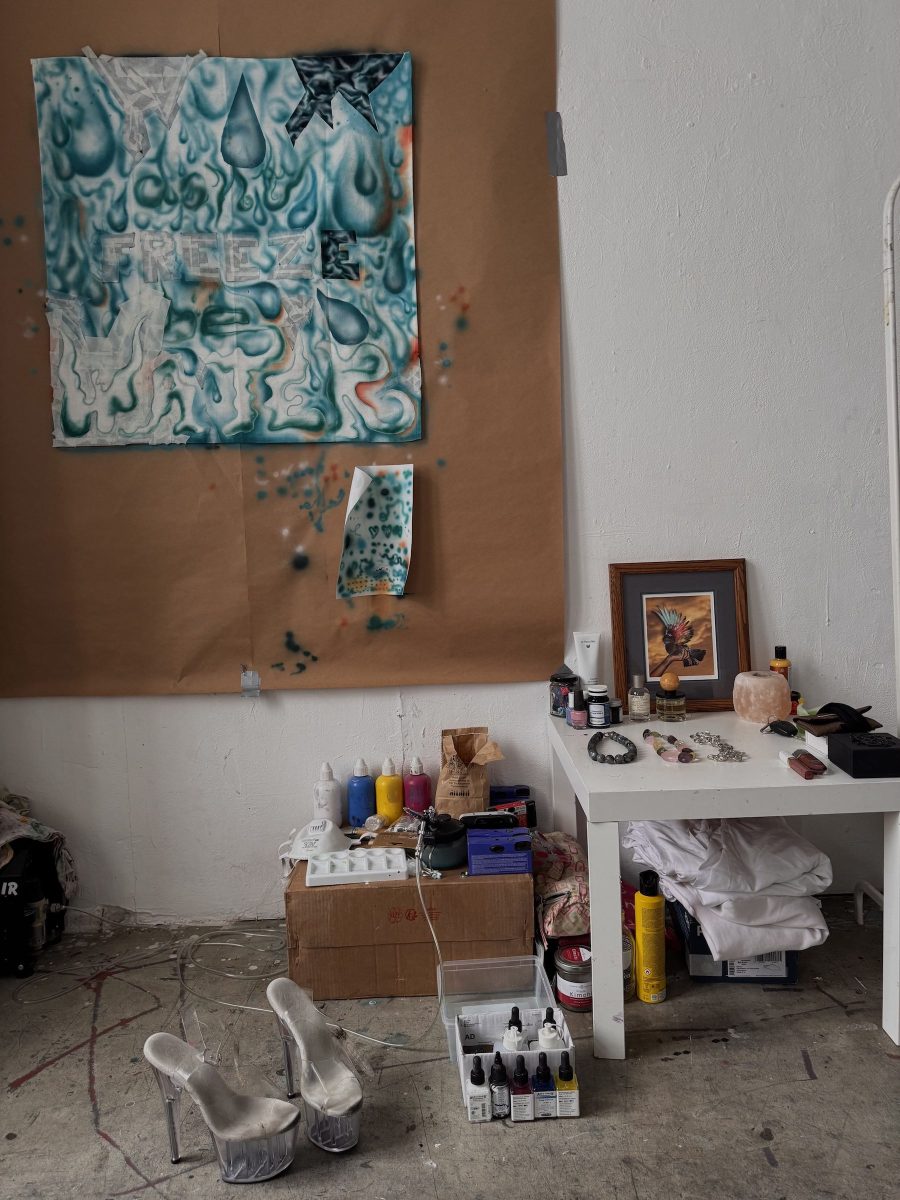
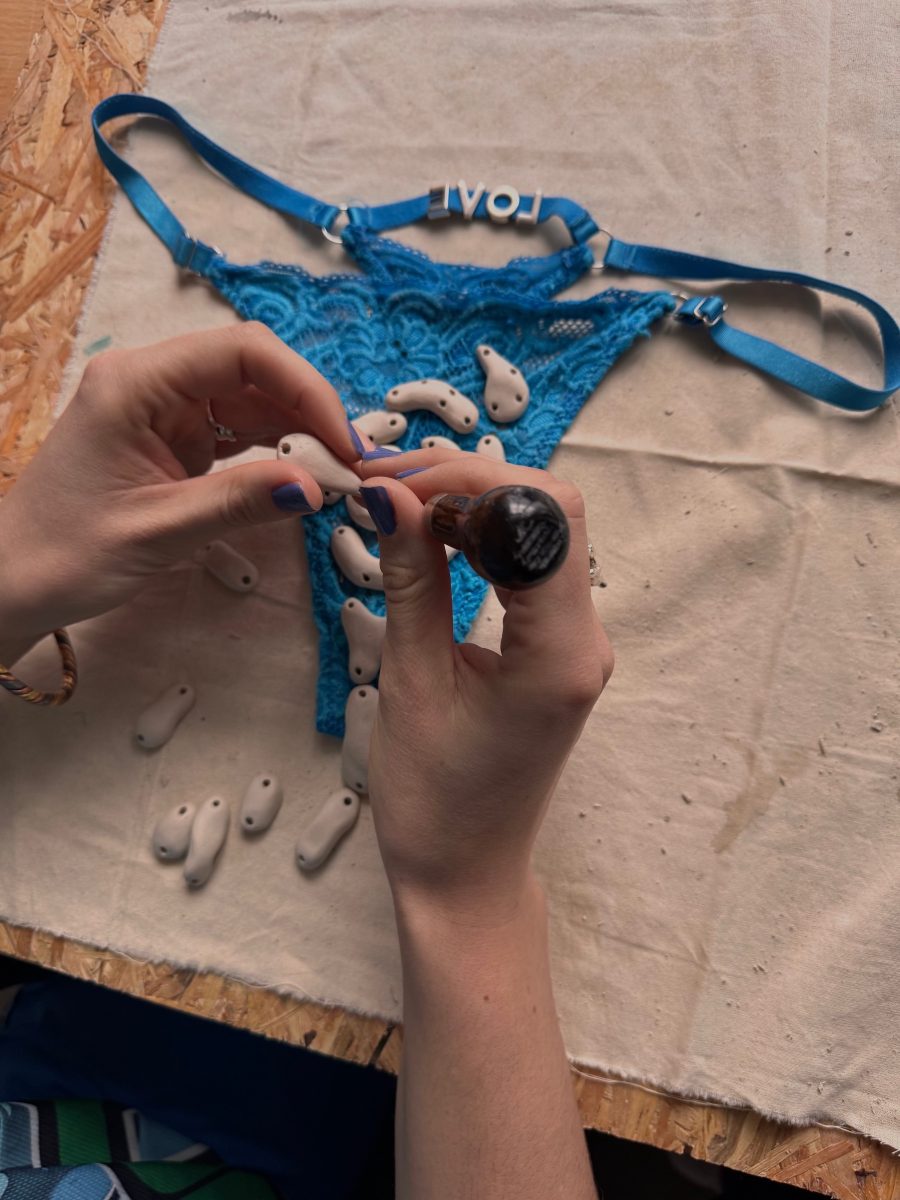
They are like organisms that inform each other. When I discovered ceramics, this material became quite special to me because it taught me so much about slowness in a time where I really needed this. It feels very meaningful to spend time with the clay, I feel like it can hold memories and be a way to process experiences.
Painting feels more like a diary or like a direct translation from my brain on the paper. And then the performance, I think, is just the most confrontational, but also the best way of connecting with an audience. I find it the most powerful tool to load the space with a certain ambience that some people in the audience might take with them when leaving.
Interview Reese Saddler (@reeseesaddler)
Photos Ksenia Proskuryakova (@ksenyapro)