Meet the On-line Artist // Tiphaine Scott de Martinville
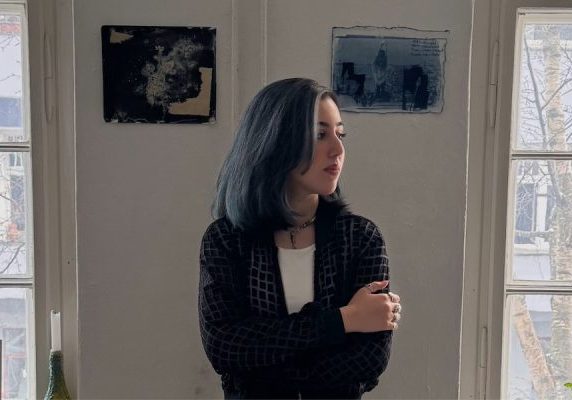
Tiphaine’s practice explores forms that keep trajectories open through detours, material encounters, and spatial arrangements. Working across painting, drawing, scrolls, invented signs, objects, sound, and installation, the artist creates what they call Theatres of Thought: environments where language is projected, rolled, sealed, handled, or set into motion. Rather than representing journeys, these works invite visitors to pause, wander, and discover their own paths. Language is treated as both material and pathway—something to trace, displace, obscure, activate, or intentionally leave unfinished.
To start, could you introduce yourself and give us an overview of your background?
I am a French artist based in France. My path to art has been indirect. For many years, my artistic practice developed alongside work with language, relationships and situations of change: first as a lawyer, and later through mediation and the facilitation of professional conversations. That experience made me attentive not only to what is said, but to the frameworks that make speech possible, direct it and sometimes constrain it.
Drawing, writing and making gradually became an inner line of orientation. The two trajectories now meet around language, but they do not merge. I do not make art to improve professional practice; I use art to examine what speech becomes when it is no longer required to resolve, align or perform. It can remain contradictory, unfinished and open to relations that have not yet taken form.
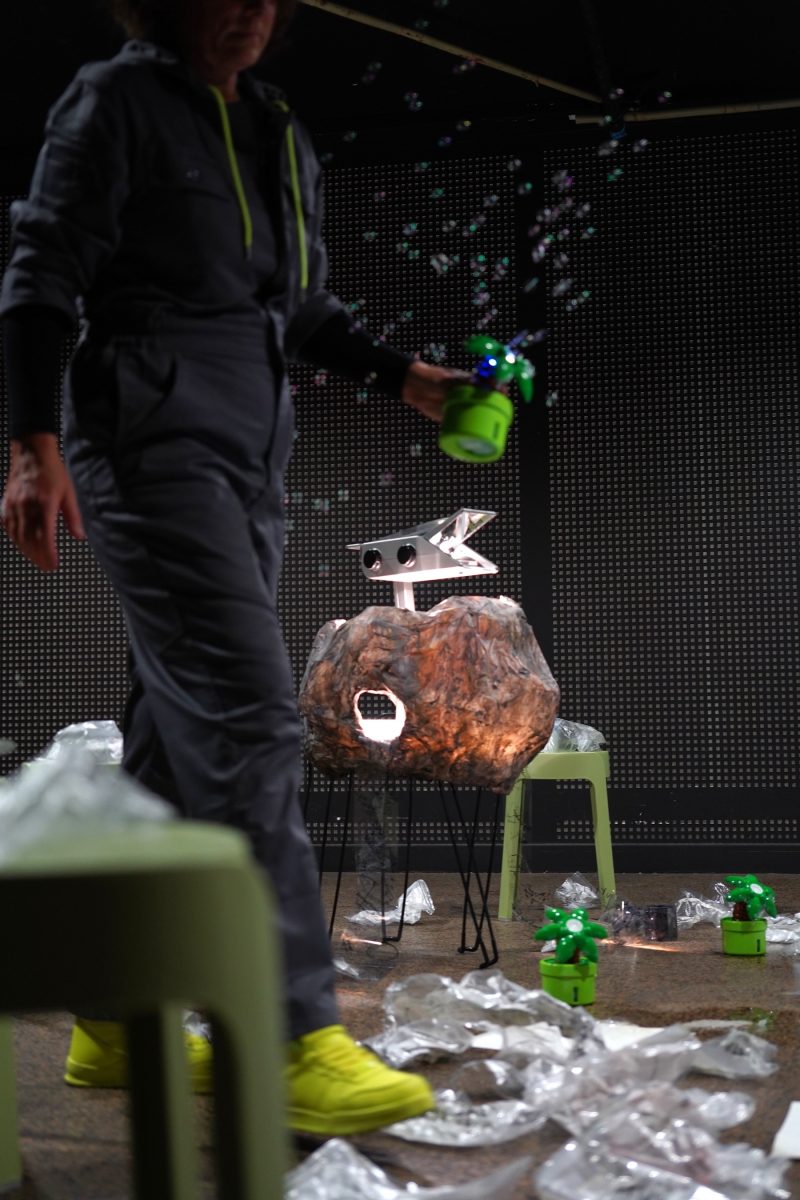
Moving through a Theatre of Thought (2026)
Twelve stools form a circle for exchange, within which stand three metal structures, each dedicated
to a medium: an overhead projector, a video projector, and sound equipment. Vacuum-sealed speech
fragments and bubble machines are placed on the floor. Variable dimensions. Mixed media.
Documentation: Minh Sounrintha.
How did art education change the way you think and work?
My relation to art changed when I placed this creative trajectory in direct conversation with contemporary art through an intensive period of study. I graduated from the DNSEP programme at TALM Le Mans in 2024, then completed the Non-Visual Art programme at L’ENDA and the EDAM Master’s programme at Paris 8 University.
The decisive shift was learning to think through making. Coming from law, analysis and dialogue, I was used to working through language. Art taught me that a question can be moved through material, scale, space, rhythm, resistance and failure. A thought can be drawn, rolled, enlarged, sealed, walked through or spoken again. I do not always need to understand something before making it; making can itself reveal what the question was.
Art gives uncertainty material conditions in which it can become perceptible, embodied and shareable without being resolved. Art does not provide ready-made answers; it allows an active relation to what is not yet determined and to paths that are still being made.
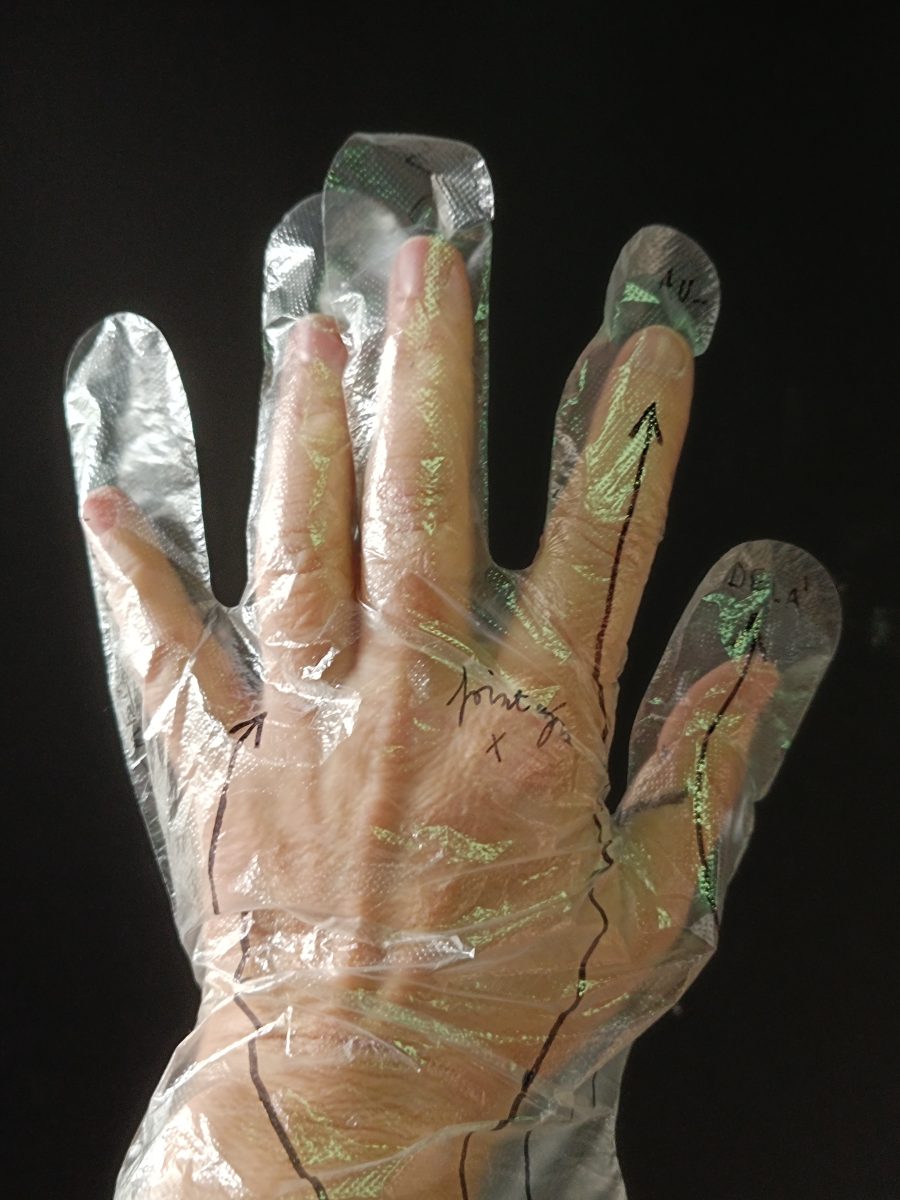
Passage Glove (2026)
Transparent protective glove bearing hypothetical trajectories.
20 × 15 × 2 cm. Transparent glove, black felt-tip pens.
Documentation: Tiphaine Scott de Martinville.
How would you describe your artistic practice?
My practice is multidisciplinary and moves between handwriting, drawing, text, objects, installation, sound, performance and digital tools. I work with speech as a situated material, shaped by the conditions in which it is uttered, heard, reformulated and retained. I write it, fragment it, roll it up, conceal it, project it, translate it into signs or let it occupy space.
Across these media, I return to four connected gestures: giving a state of thought a perceptible form; making room for speech; turning words and traces into forms that can be handled, crossed or navigated; and allowing new speech to emerge from the encounter. They form a loop rather than a sequence. Speech becomes live graphic notation; notation becomes drawing and text; these may become a scroll, a logogram, an object, a projection or a spatial arrangement; a body then activates them, and the experience can return as speech or another trace.
Because many notes are written in the first person, the word ‘I’ circulates between the person speaking, my reformulation and voices accumulated from other conversations. I think of this unstable speaker as a ‘choral I’.
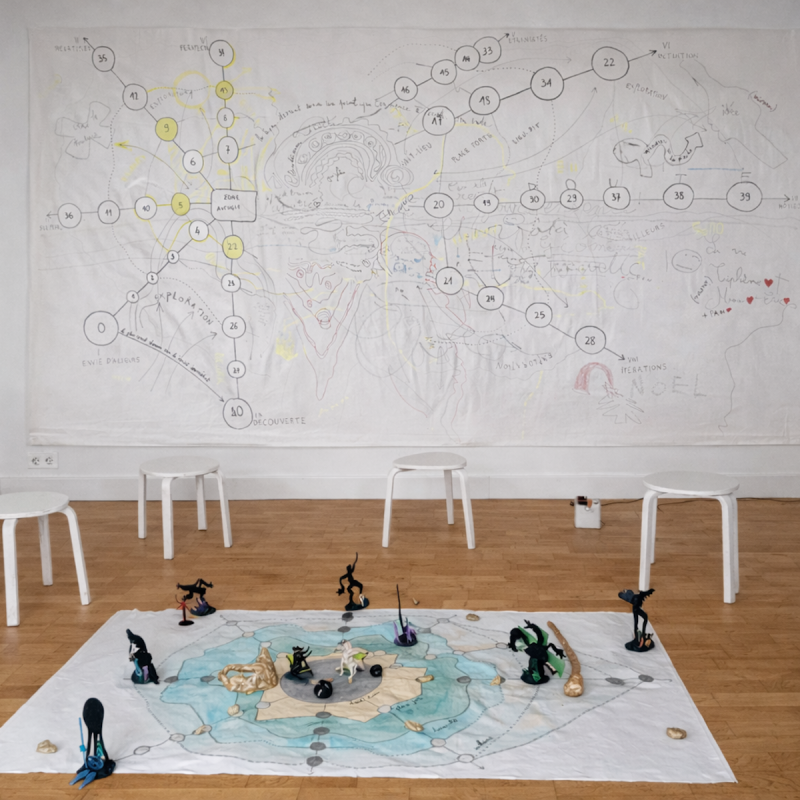
I call some of the resulting configurations ‘theatres of thought’: activatable arrangements of words, images, objects, seats, sounds, bodies and positions. They are spaces of advenance, not representations of a finished thought but situations in which something still unformed may take shape. Until they are read, crossed, voiced or manipulated, they remain scenes in waiting.
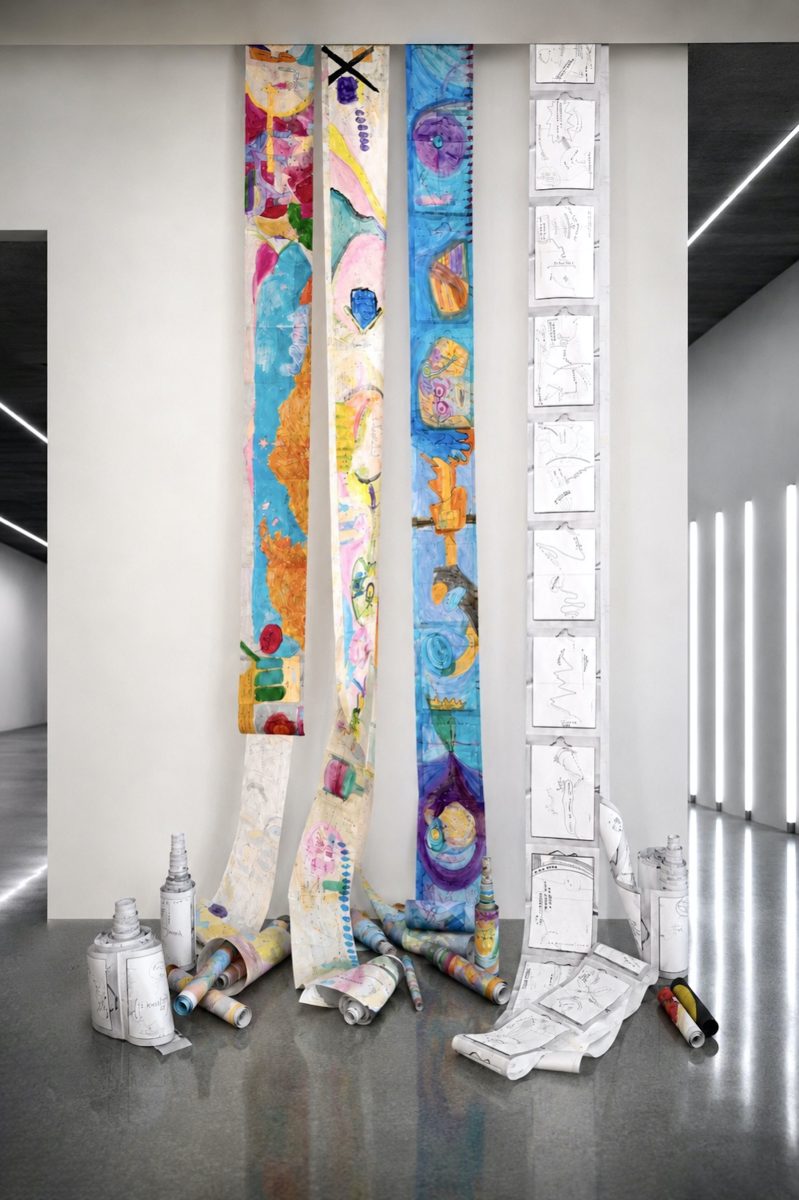
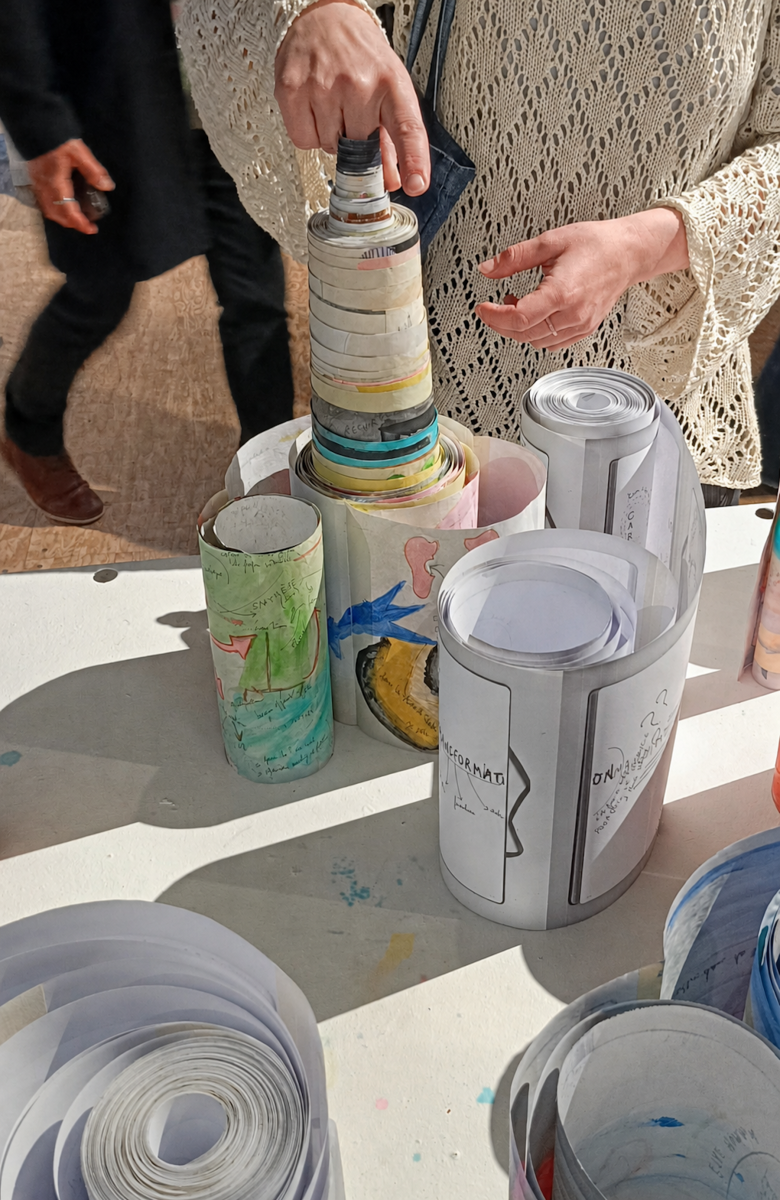
Mental Films (2025)
Assemblage of painted photocopies from notebooks containing phrases gathered during
facilitated conversations in professional settings. 400 × 250 × 100 cm, variable dimensions.
Photocopies on A4 80 gsm paper, acrylic paint, painter’s tape.
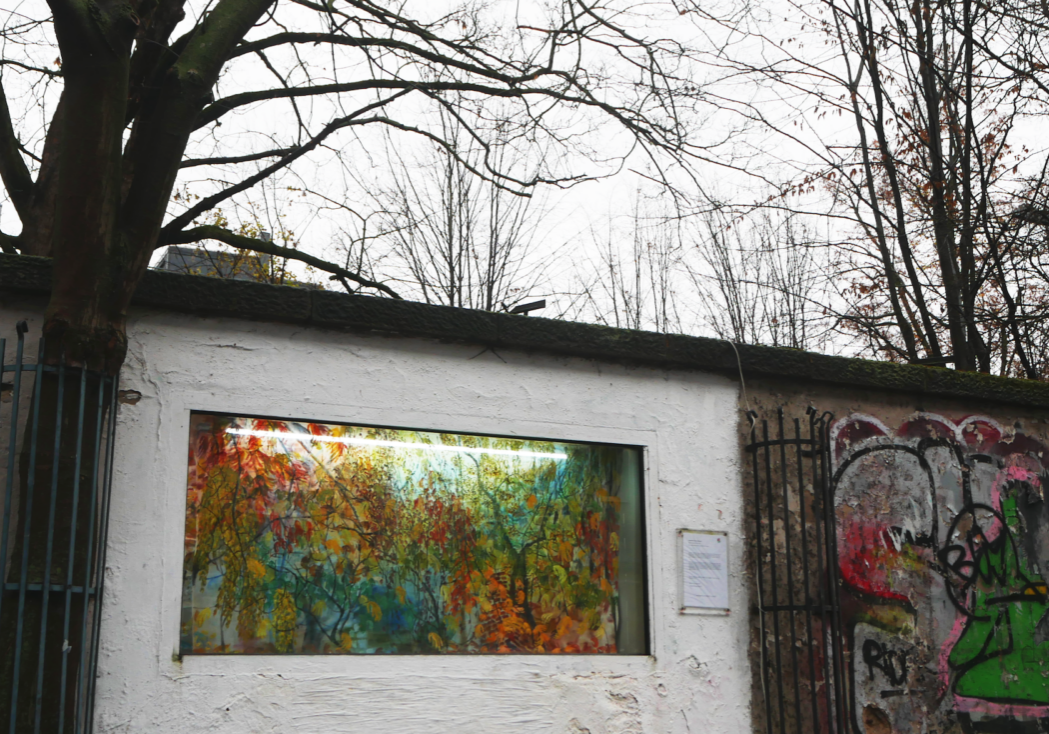
Left: Spatial visualisation based on the original installation photograph, The Window (2025), Paris, France;
surrounded by an architecturally modified digital context.
Right: Activated during the group exhibition Less Than an Image, Galerie Adada (2025), Saint-Denis, France.
Documentation: Tiphaine Scott de Martinville.
What is your methodology or process for creating a new project?
I often begin with a word, image or contradiction that I cannot yet fully explain. Research then moves by association: etymology, artworks, philosophy, maps, organisational language, everyday objects and gestures. I am interested in the moment when elements from different contexts begin to affect one another.
My notebooks are central to this process. The yellow ones hold visual research: drawings, diagrams, references, project notes and fragments that may return much later. The blue ones contain graphic notes taken live during facilitated conversations in professional settings. I keep them without names or dates. A phrase may continue across several pages; arrows, loops and opposing statements trace a movement rather than produce a transcript. Sometimes I share a page on screen, so the writing briefly returns to the situation that produced it.
What matters to me is not documenting a person’s story, but making the structure of a tension perceptible: two incompatible injunctions, a hesitation, a repeated ‘but’, a line that breaks, circles back or seeks passage. The artworks do not reproduce individual conversations. I select and recompose recurrent words, forms, rhythms and relations, then test what happens when their material conditions change: when a page becomes a scroll, when writing is enlarged, painted over, made transparent, vacuum-sealed, projected or translated into a manipulable sign.
Chance is also part of the method. A ruled page, an accidental fold or a resistant material can answer the question differently and redirect the work. Detours are not deviations from the process; they are often the process itself.
I am increasingly attentive to what happens after a work is activated. The way a body sits, chooses, refuses, moves an object, returns or leaves a trace can reshape the next version of the work. The construction of the device and the trajectories it produces therefore remain connected.
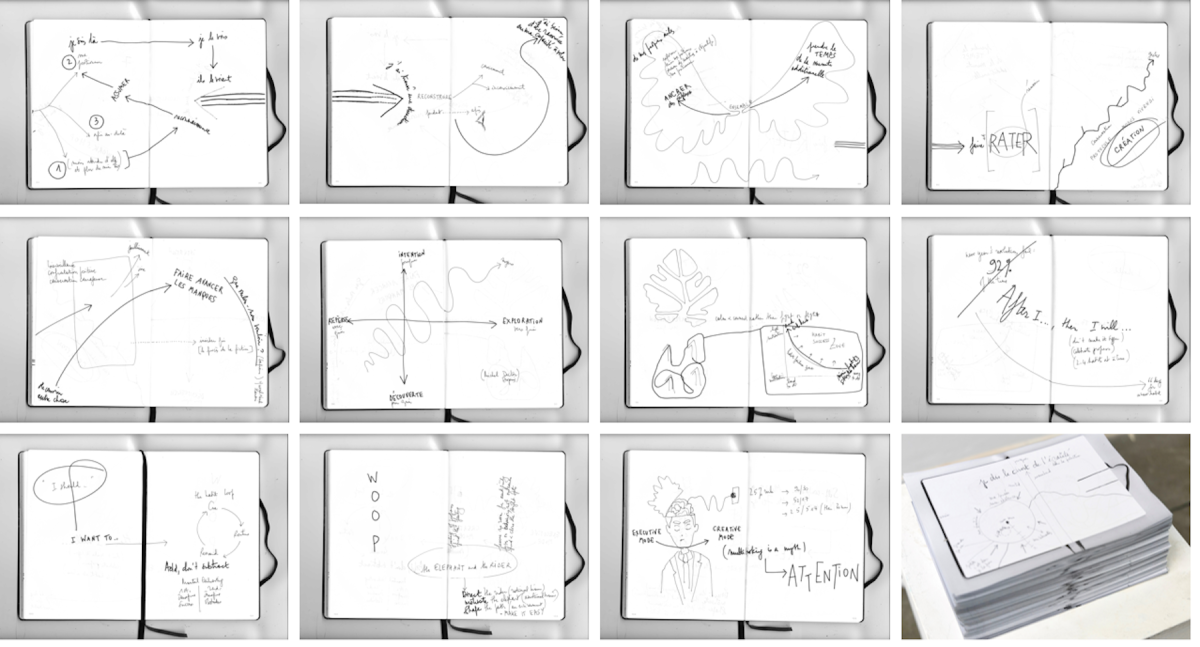
Portraits of Emerging Minds (2022–2026)
Graphic notes produced during facilitated conversations in professional settings.
35.5 × 25.5 cm each. Black felt-tip pens on A4 80 gsm paper.
Documentation: Tiphaine Scott de Martinville.
Tell us about the project you are working on during your residency at GlogauAIR.
During my residency, I am developing L’Élanographe, a research-creation project centred on (dis)orientation. It takes the form of an interactive digital navigation booklet and a compass without a fixed North. The project grows from a new reading of selected double-page spreads from my speech notebooks, and asks how other paths might be made from what we already see and take to be real.
The project begins with élan: an indeterminate force of orientation rather than a motivation or an obligation to move forward. It may appear as hesitation, withdrawal, contradiction, detour or return before it knows its direction. I call the search for an orientation towards a desired but still unknown horizon ‘horizodesie’.
I am tracing recurrent words, oppositions, rhythms and graphic gestures: statements such as ‘I must’, ‘I want’, ‘I cannot’, ‘but’ or ‘what if’; voices that push, restrain, balance, circle back or seek passage. Because the first person moves between speakers and reformulations, this material forms a ‘choral I’ rather than a sequence of individual portraits.
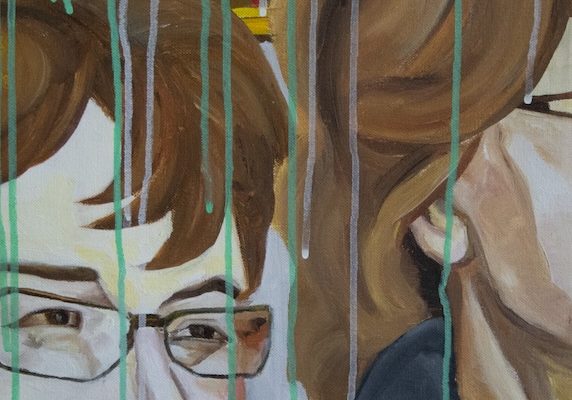
A recent group of drawings uses Janus—two faces joined in one head but looking in opposite directions—to explore how incompatible orientations can belong to the same body without one cancelling the other.
The booklet will organise these elements through routes, cross-references and tensions. Entry, detour, return and exit operate as recurring functions rather than fixed stages. Readers may follow one voice, encounter its opposite, refuse a direction, return to an earlier point or leave a trace. The compass will not reveal a destination or a true self; it will make contradiction navigable without resolving it.
At a time when interfaces tend to optimise choices and predict behaviour, I want to create a slower, playful and non-prescriptive environment. Like my installations, L’Élanographe remains incomplete until a reader activates its routes, interruptions and returns.
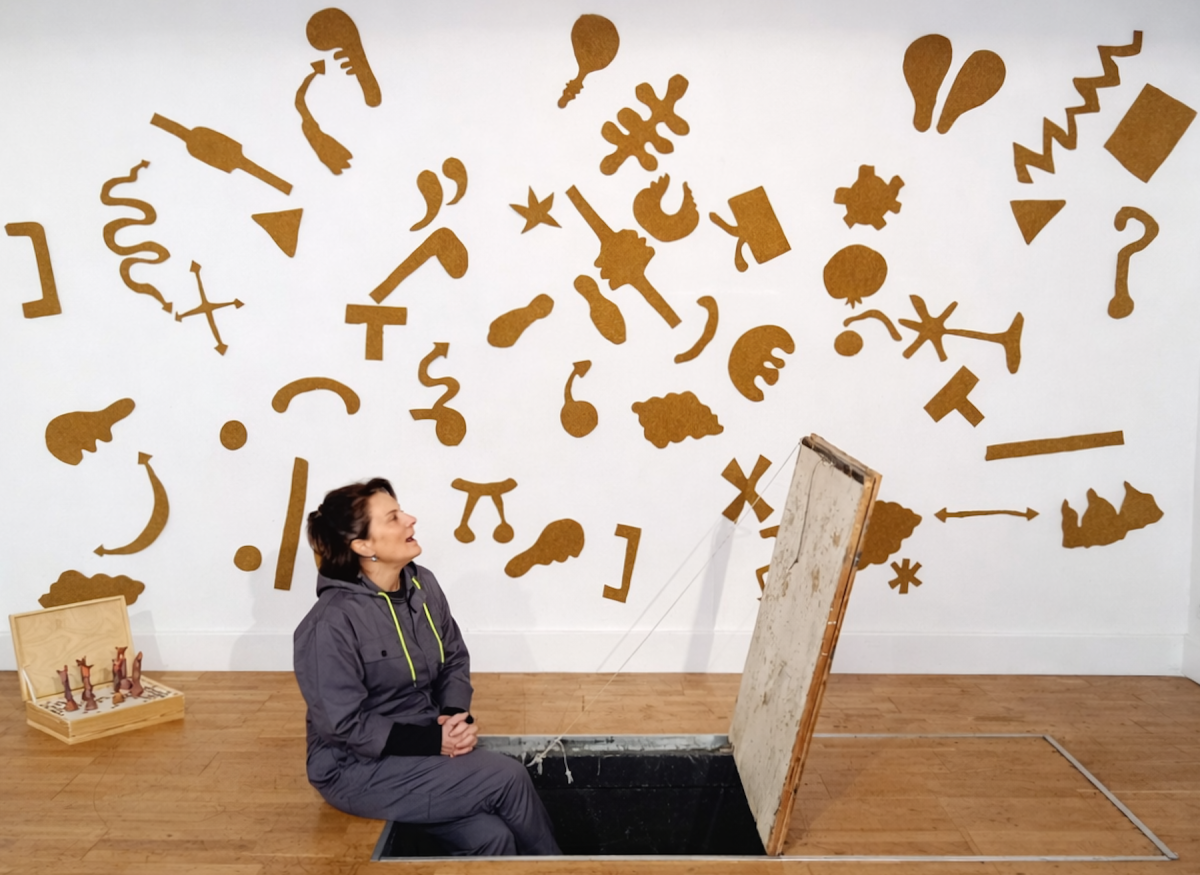
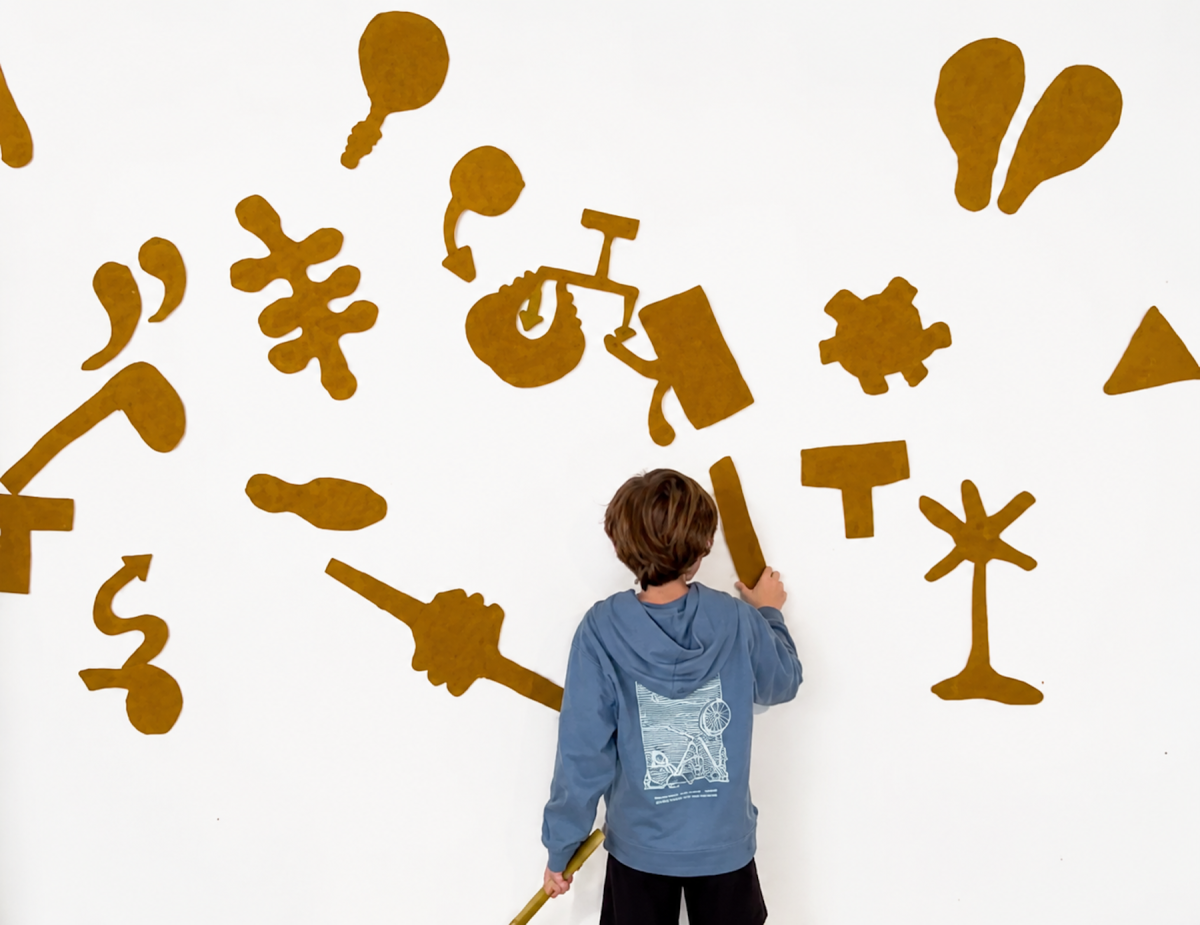
Logography (2024)
Left: Logograms for a Black Hole performance (2025), The Window, Paris, France.
Reading and activation of 41 vocal-visual signs composing an exploratory alphabet.
Variable dimensions. Reclaimed acoustic material.
Documentation: France Hervé.
Right: activated during the Inside Out happening (2025), The Window, Paris, France.
Documentation: Maxime d’Hauteville.
What role does participation or the viewer’s movement play in your work?
Participation takes different forms and intensities in my work. Some pieces invite direct actions such as rolling, reading aloud, drawing, choosing a route, sitting down or moving an object. Others ask only for an interpretive movement between elements whose relation is not immediately clear.
Seats are important in many installations. Empty, they already mark a place where speech or encounter may occur; occupied or moved, they become active parts of the situation. I think of many works as dormant rather than complete. They become active when a body, voice or attention sets their elements into relation.
There is no correct performance. A pause, refusal, return or detour can also activate the work. I am interested not only in constructing the device, but in the partial evidence of its traversal: an object displaced, a route abandoned, a phrase reformulated, a mark or a return. These are not proofs of transformation, but signs that something occurred in the relation between a person and the work.
I hope these situations create a small interruption in the usual speed of interpretation. I do not seek to deliver a lesson or transform the viewer. A slight displacement is enough: something familiar becomes less obvious; incompatible directions remain present without demanding an immediate choice; or another orientation becomes imaginable. In L’Élanographe, the reader’s choices and interruptions become part of the route itself.
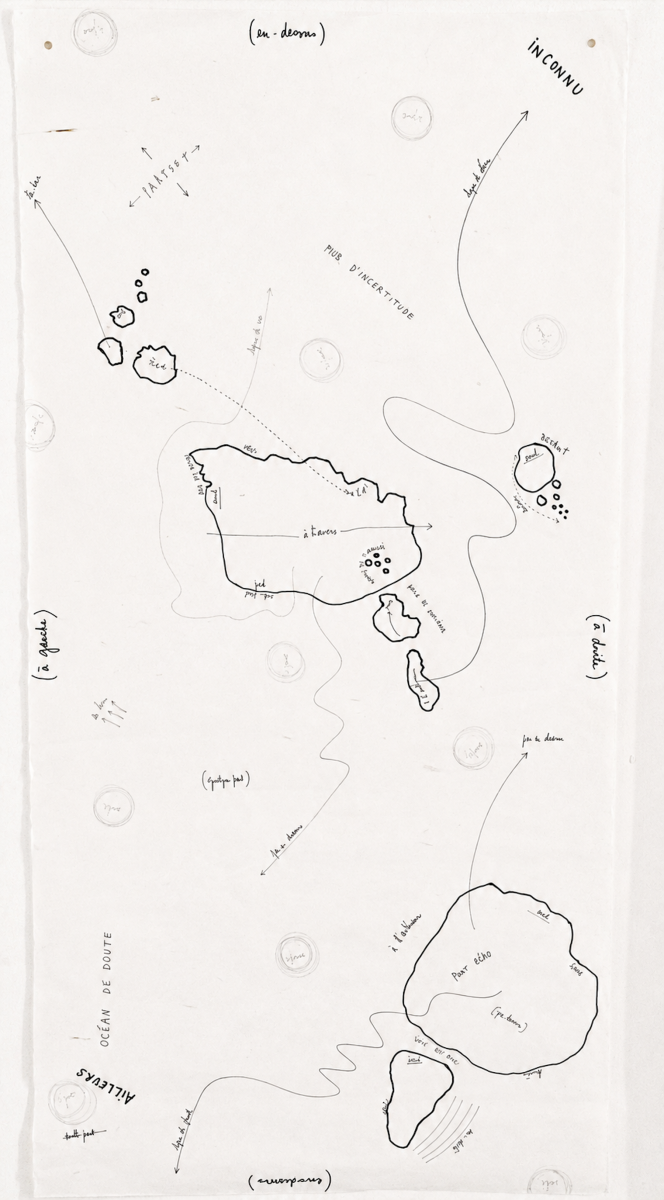
Deictic Map (2025)
110 x 80 cm. Black felt-tip pens on Chinese paper.
Documentation: Tiphaine Scott de Martinville.