Meet the Artist // Lara Marino
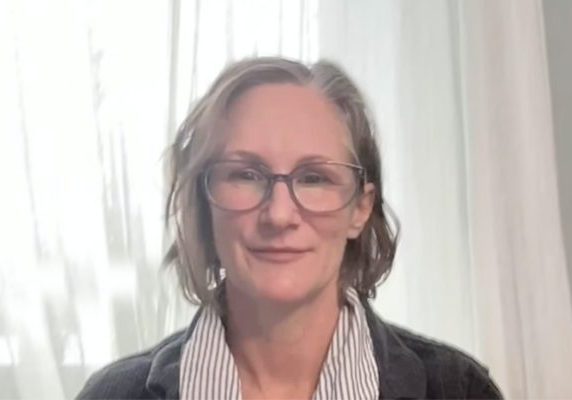
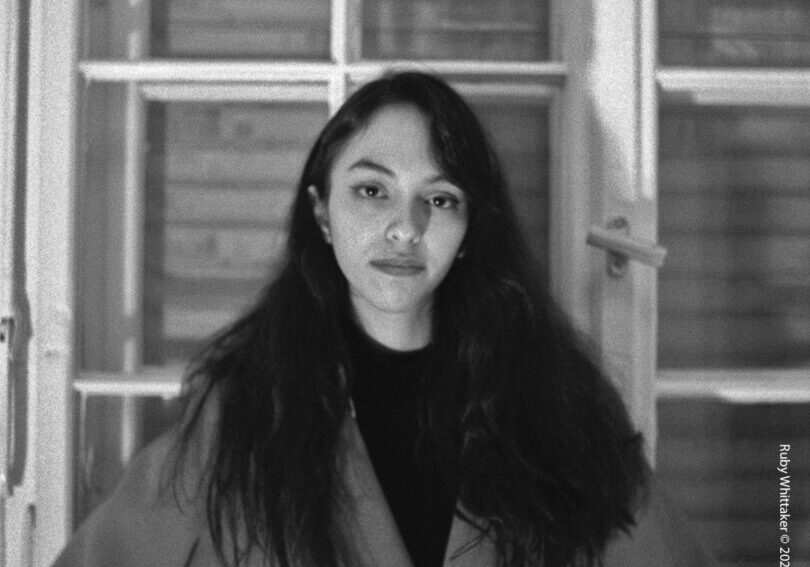
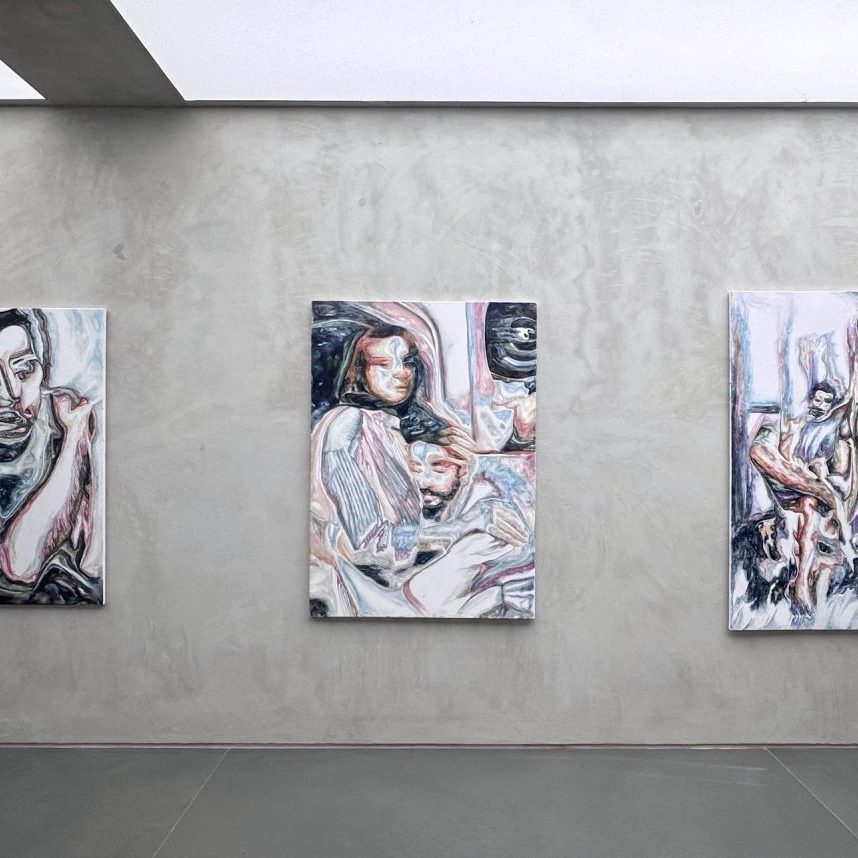
Lara Marino is a Swiss artist whose practice unfolds through painting, drawing, and writing. It engages states of psychic and bodily tension, and the ways unstable images persist, fragment, or disappear. Painting becomes a space of continuous transformation, where matter, memory, and gesture remain in a state of crisis.
Can you tell me a bit about yourself and what you’re working on for your residency?
I graduated with a Bachelor of Fine Arts from École cantonale d’art de Lausanne in Switzerland. At that time, I was doing multidisciplinary art. After this, I went to Indonesia and spent two years there after my studies to reconnect with my home.
After the residency, I’m going to do a Master’s of Fine Arts at the Royal College of Art, because I really want to focus on painting more.
I also started an art collective in Switzerland, called Space 28, in order to build a community between artists, especially for emerging artists. For me, doing a residency was one of the keys to doing this because I wanted to work in a community and to build links with other people from other cultures as well.
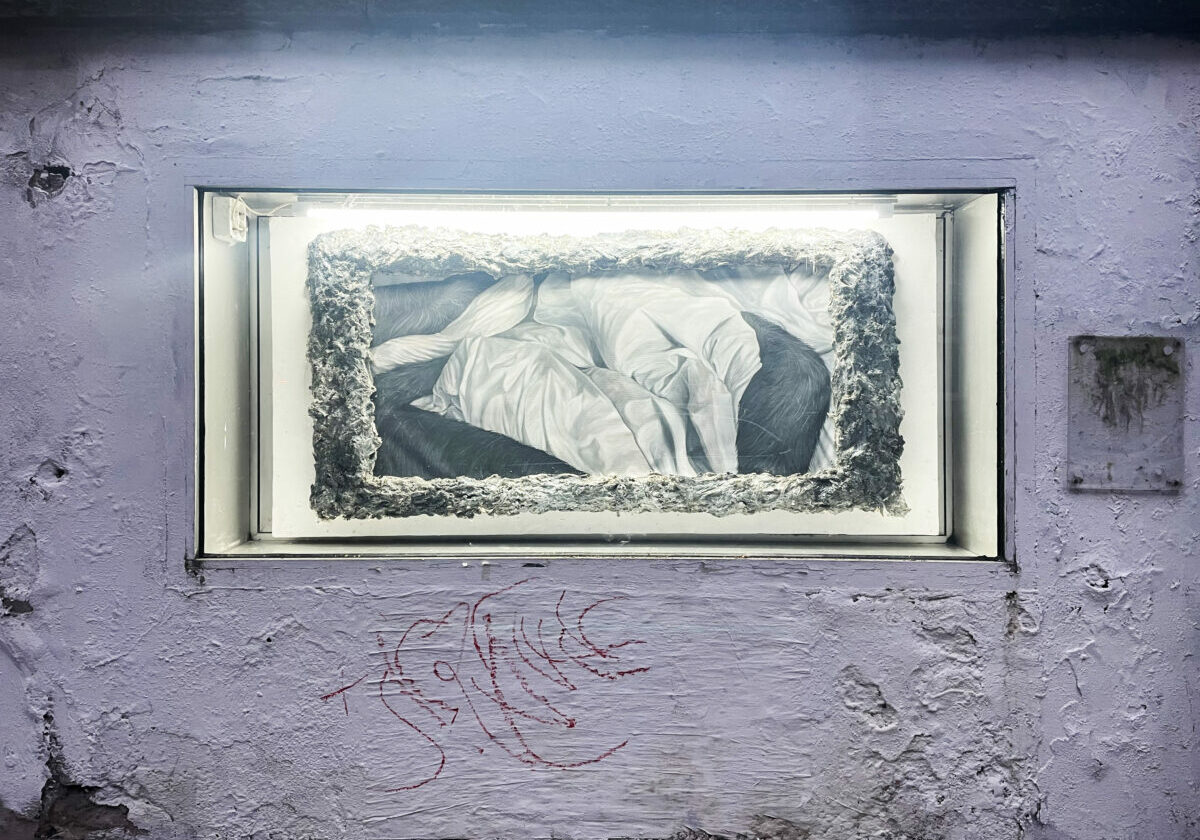
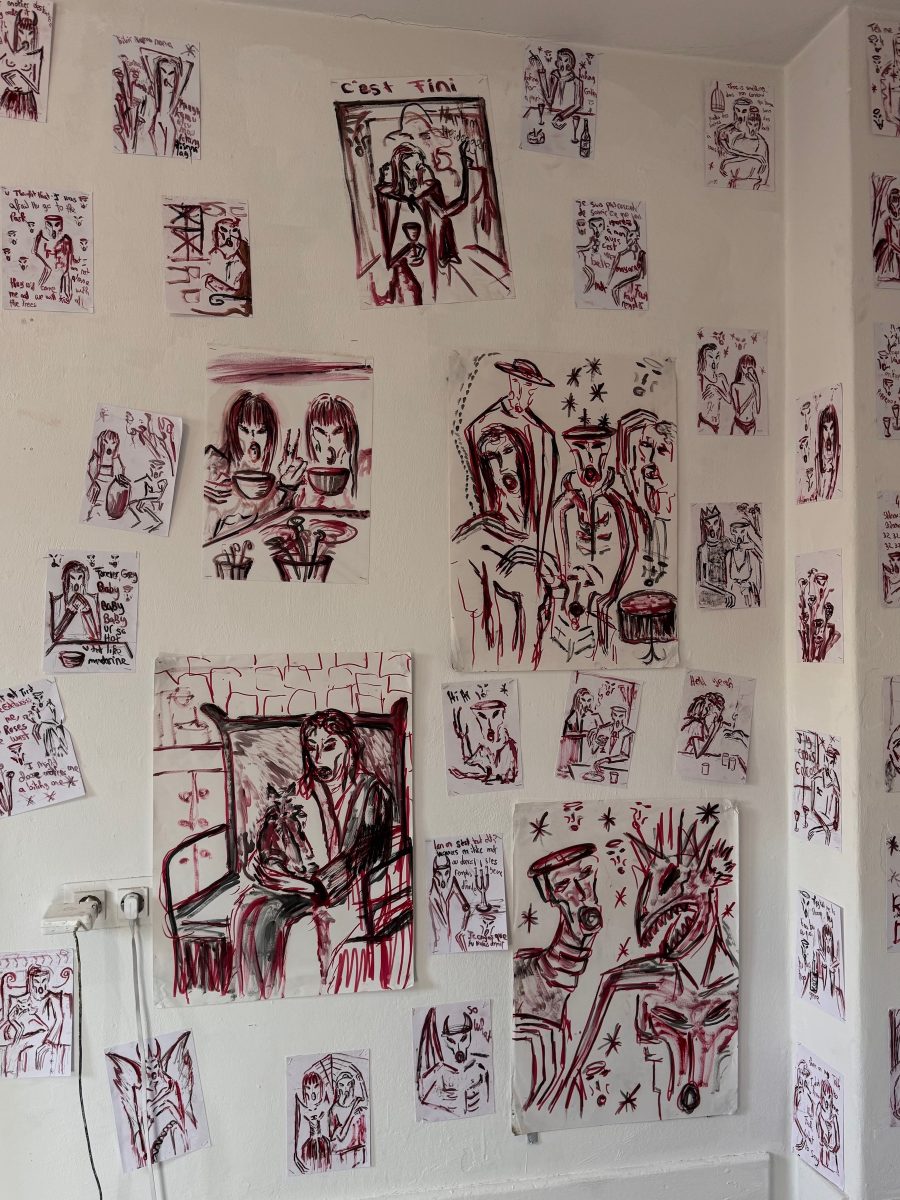
I have two different practices: functional and quick drawing and painting. Both function as extensions of each other. My work is mostly focused on the female body under pressure. I question that relationship and the relationship between the environment and the woman’s conditioned body.
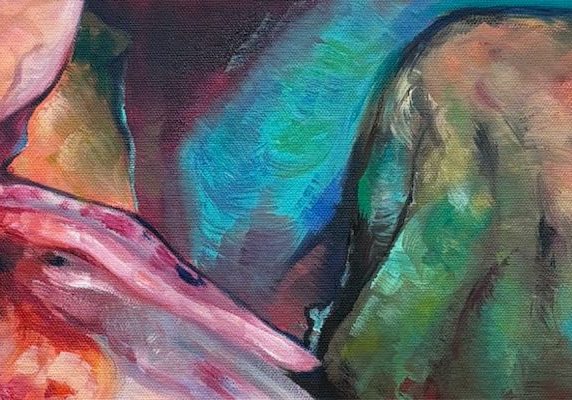
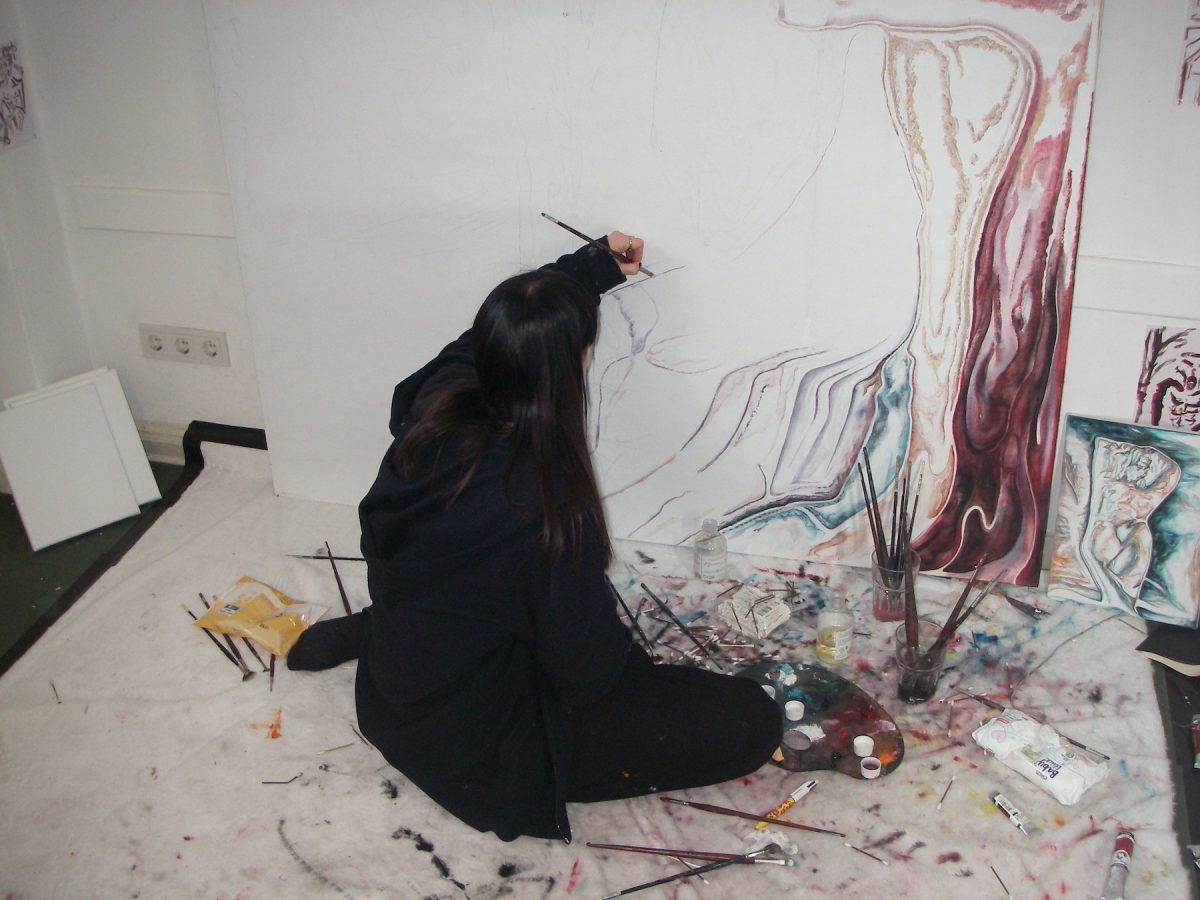
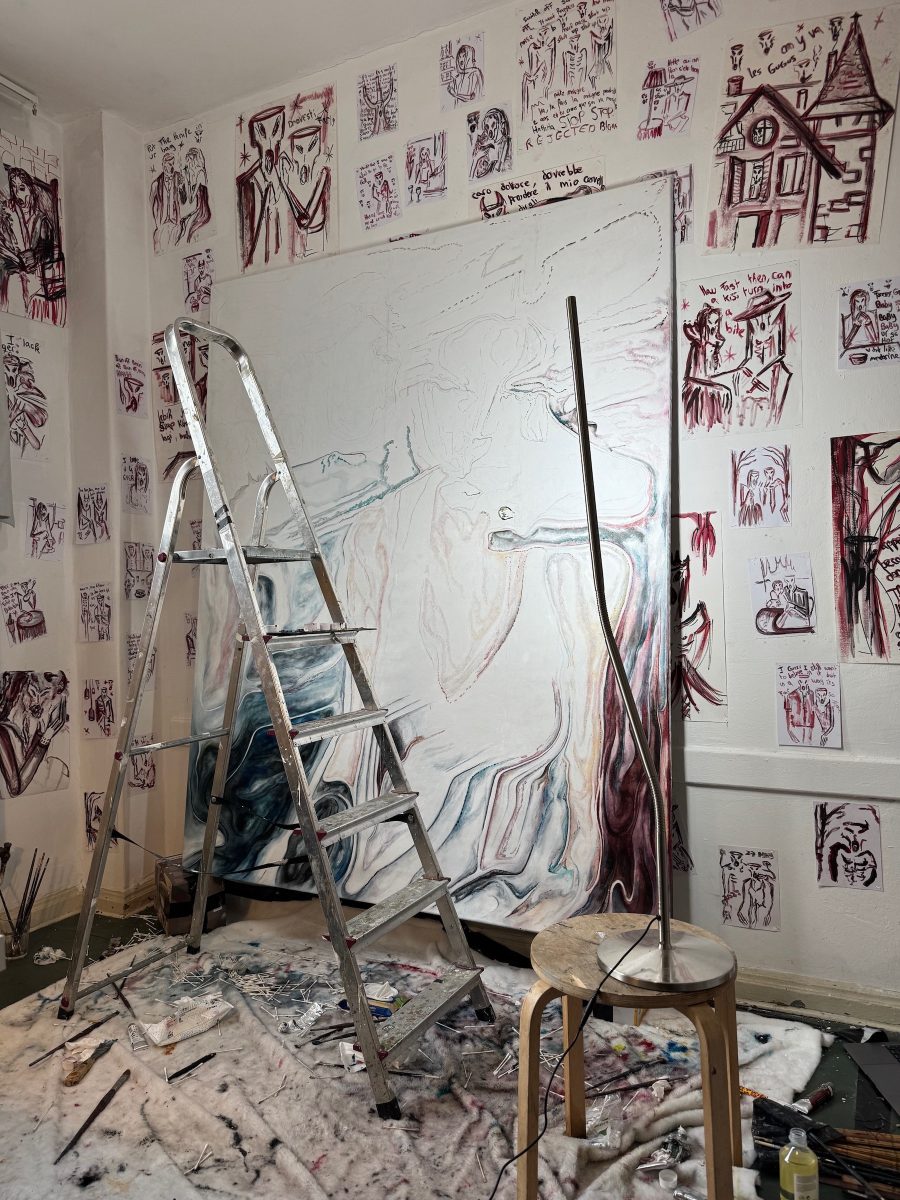
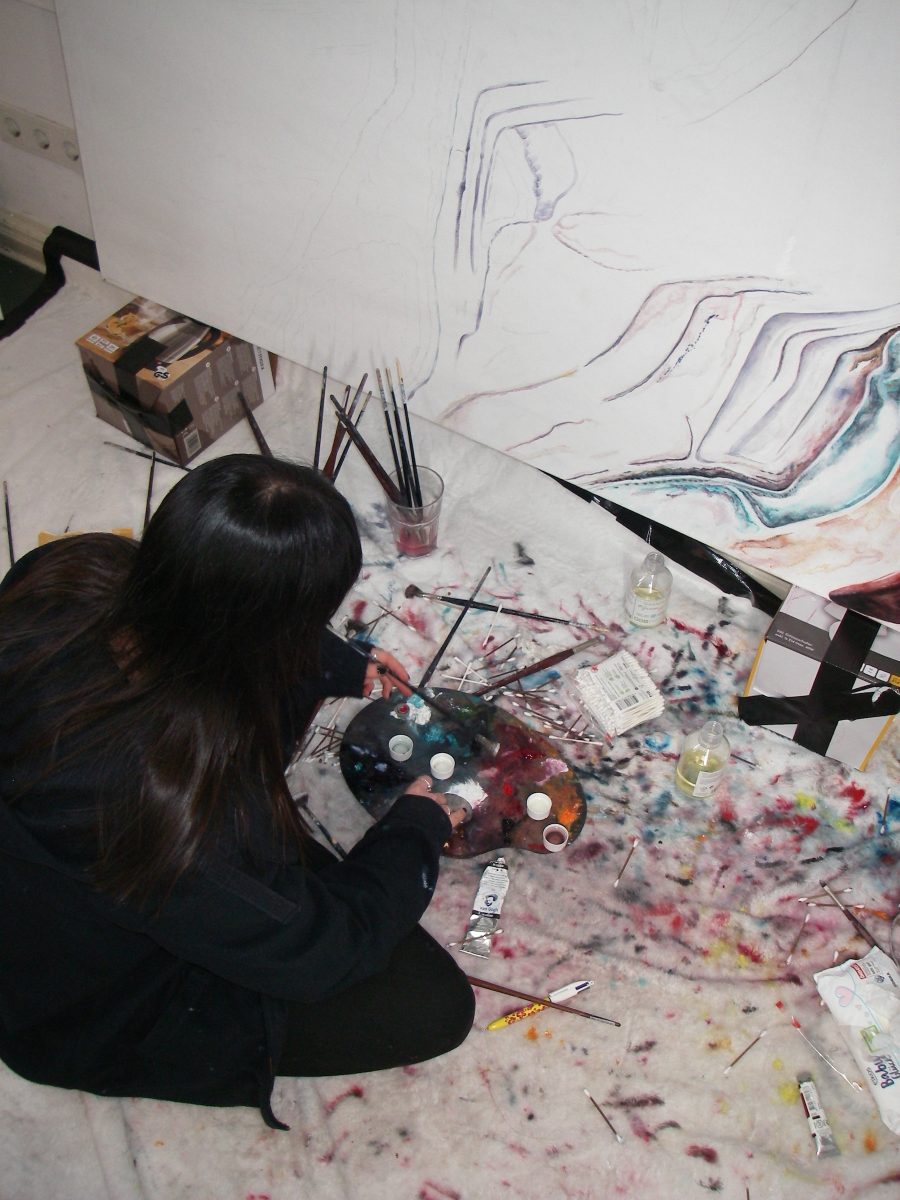
I’m mostly focused now on the practice of painting, mostly working with oil paint. Sometimes I combine the oil with my own blood, but it was a bit difficult to bring my own blood here. I’m interested in the link between the environment and human beings, as well as the relationship between the process of painting and the act of self-destruction.
The oil is really slow and dense, yet the blood is oxidative and organic. So they have this relation of self-destruction in the painting. And I’m really interested in this destruction.
And it’s good because I like the material. It’s not the color. I’m not interested in the color of the blood. It’s about this difference between the two materials, like a fatty and dirty one, and one that’s very transparent and almost like water.
During your time at GlogauAIR, you’re exploring how feminist writing influences your painting process. What excites you most about letting text and image “mix” or influence each other more directly?
I will always be more comfortable trying to have a conversation about my work and talking about other artists that I feel related to before trying to explain a specific work. When you are still in the process of understanding how your work functions, it’s easier to relate to people who you are influenced by.
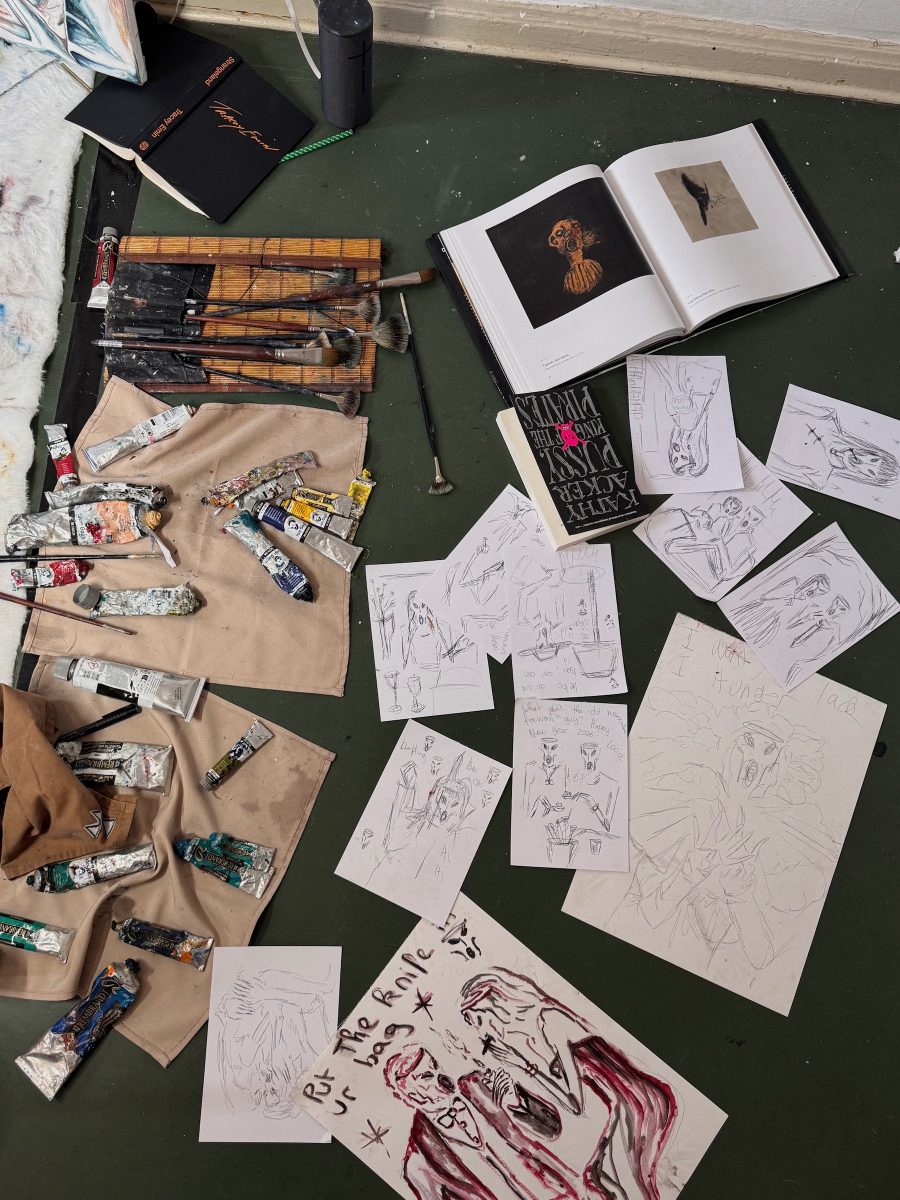
I’m influenced by Tracy Emin, Kathy Acker, and also Hélène Cixous. Cixous is an eco-feminist writer, and she writes about this condition between the body and women’s pressure.
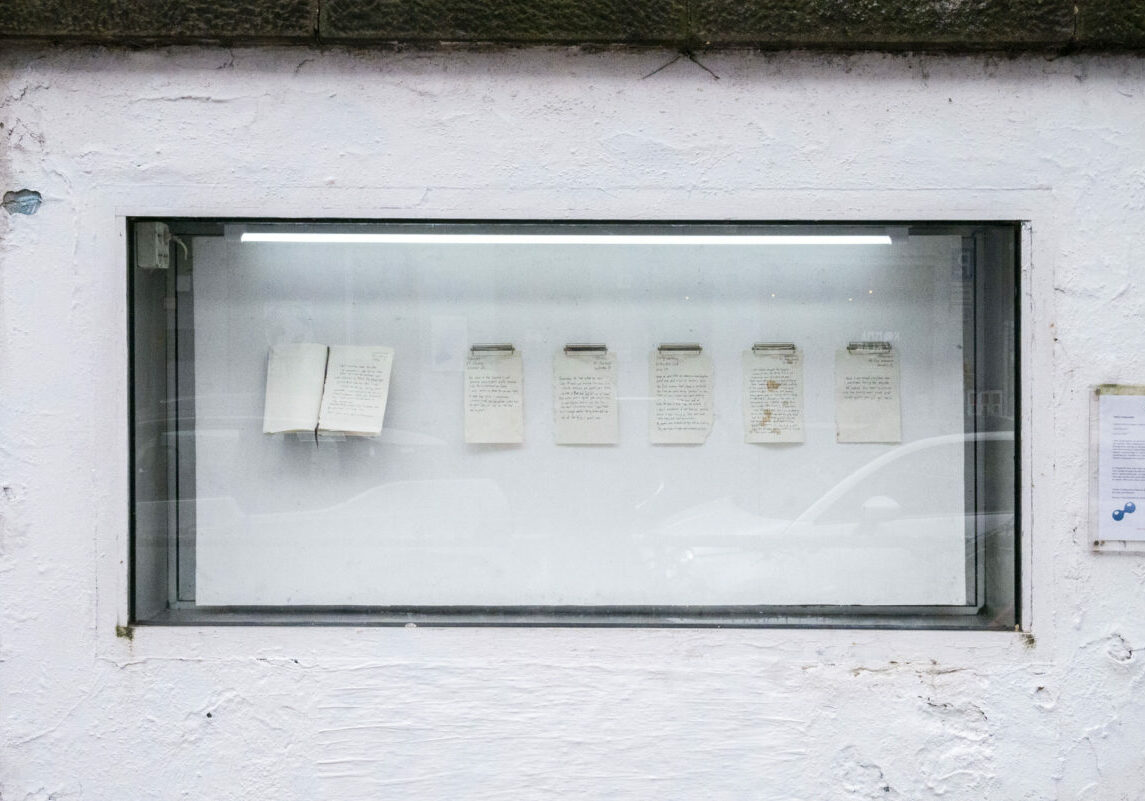
I also read texts from Kathy Acker. She has this approach in her text where it’s not from A to Z, but it’s written with a diffracted narrative distortion. I feel like I have the same relationship with the drawing; it doesn’t matter how my drawings are settled, because it works anyway.
For me, writing enters the work as a gesture close to the body and the surface. Writing communicates the same idea as the image, just in a different way. When they both enter the work, it just becomes one thingー like a body. When I’m trying to explore this, I am going very quickly. When I have an idea, I immediately transfer it, but the painting process is more about obsessive control. So working on a specific area would be like a super close-up of one narrative drawing. So this logic extends to both the body and the environment. I approach the body as an ecosystem subjected to intensive regimes of control.
In the same way, the environment is exploited, exhausted, and then partially repaired. From an eco-feminist perspective, the body and the environment are closely connected. Both function as surfaces of control and destruction, sometimes imposed, sometimes consciously maintained.
A lot of your work deals with tension, repetition, and moments of collapse. What keeps bringing you back to those themes?
I guess they are repeating, but I guess so many things are repetitive in our daily lives. We’re doing so many things as human beings; everyone is sleeping every day, everyone is eating every day. There are so many things that we are doing as repetitive gestures, but it’s slightly different every day.
As human beings, we’re always evolving. Even though the characters in my work are repeatedly coming back to my work, there is no limit to their evolution or destruction, or the way they will talk or the way they will think. In a way, I see those monsters or characters as a representation of how we are evolving as well.
They are changing every day, but sometimes they are in the same mood. Sometimes they want to be chill, and sometimes they want to be quiet.
Repetition shows up a lot in your work. What does returning to the same image or gesture again and again allow you to explore or uncover?
One thing I’ve realized about my practice is that all this logic is linked to my own experience with anorexia in the past, and it shapes my relationship to control and collapse.
This perspective or this aspect of control going through destruction is why I work with blood and oil.
I also wanted to show you the work of Marina de Van, who writes and acts in the movie Dans ma peau.
Interview Reese Saddler (@reeseesaddler)
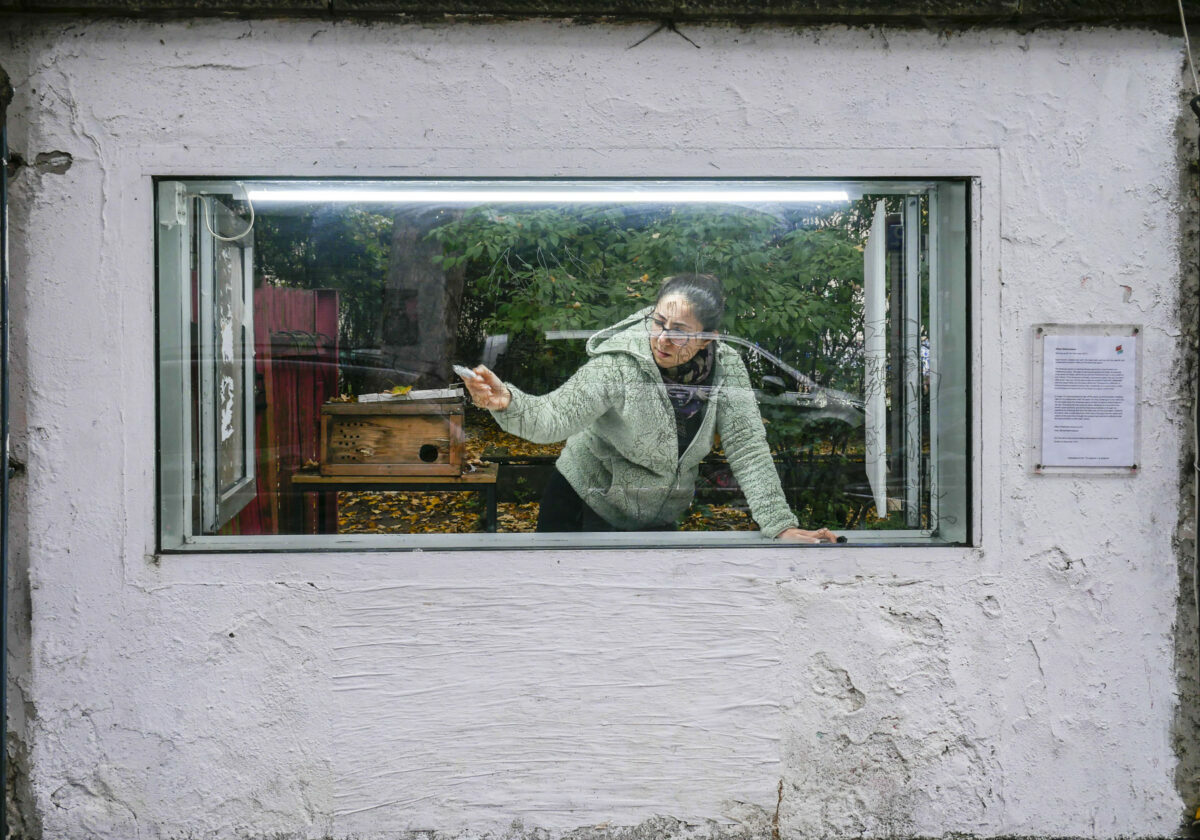
Photos Ksenia Proskuryakova (@ksenyapro)